Quick Answer
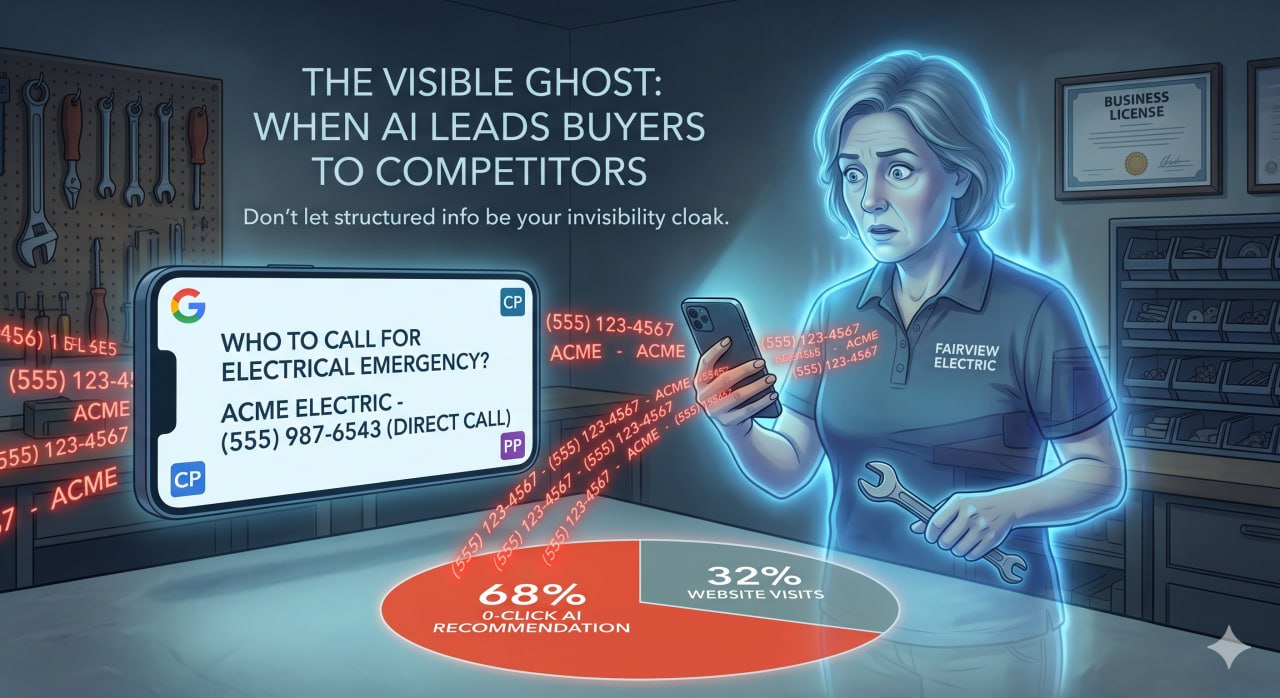
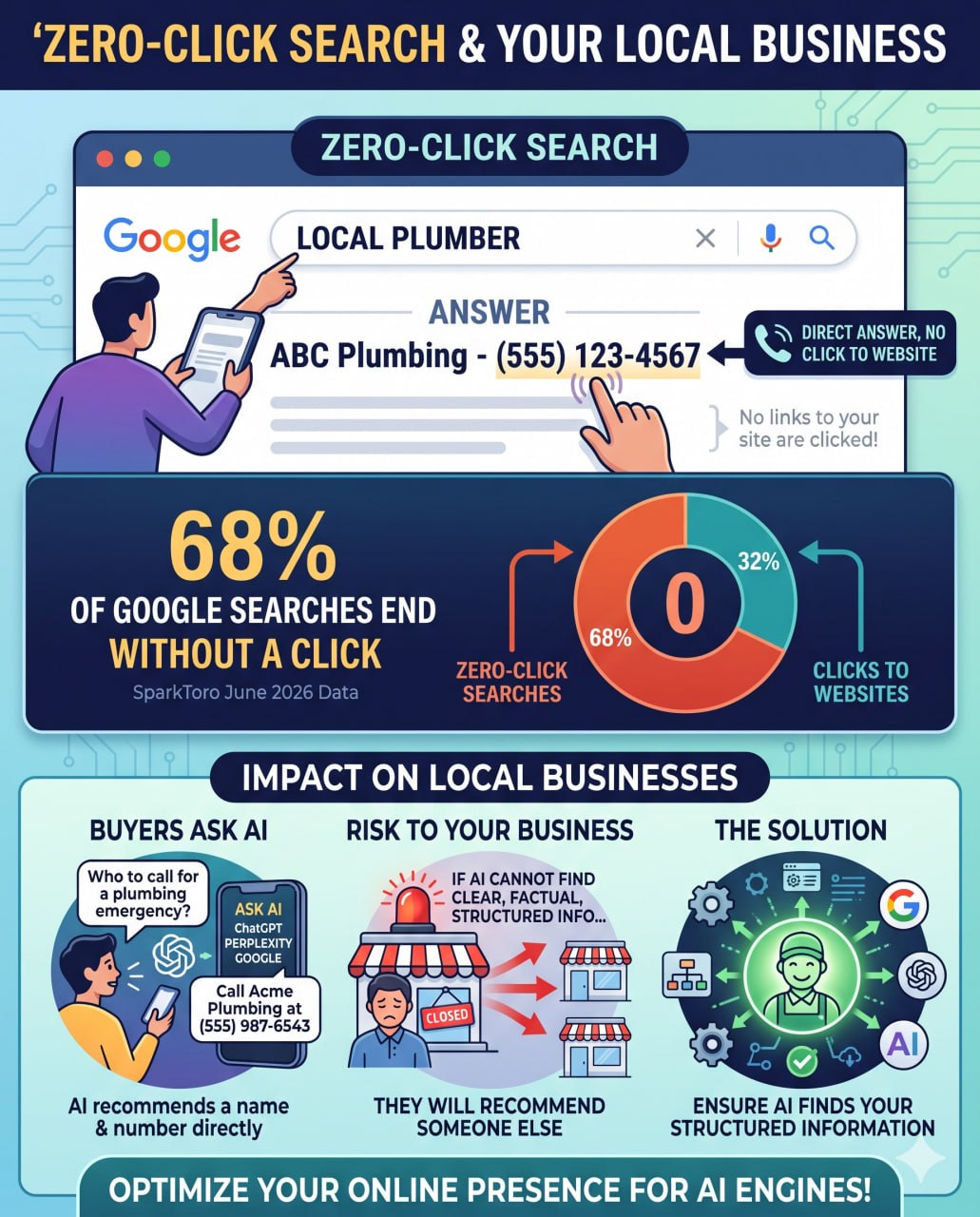
Zero-click search happens when a user's question is answered directly on the search results page, so they never click a link to reach your website. According to SparkToro's June 2026 data, 68% of all Google searches now end without a single click. For local businesses, this means a buyer can ask ChatGPT, Perplexity, or Google who to call and get a name and phone number without ever seeing your website. If AI engines cannot find clear, factual, structured information about your business, they will recommend someone else.
What Is a Zero-Click Search, and Why Should Local Business Owners Care?
Zero-click search is what happens when the search engine or an AI tool like ChatGPT or Perplexity answers a user's question right on the screen, so the user never needs to open a website. For local business owners, that means a potential customer can get a business name, phone number, and recommendation without ever landing on your site.
This is not a small trend. According to SparkToro's research using Similarweb data published in June 2026, 68% of U.S. Google searches now end without a click. That is up from 60% just two years ago. Rand Fishkin, who has tracked this data since 2019, describes Google as increasingly becoming a walled garden, a place where users get answers and stay inside the platform.
The shift matters most to local businesses. A plumber, a pediatric clinic, a window treatment company: these are exactly the businesses that buyers search for in moments of urgency. When AI engines answer those questions directly, your website traffic drops whether your rankings hold or not.
Key Takeaways
- 68% of U.S. Google searches ended without a click in early 2026, according to SparkToro and Similarweb data.
- When a Google AI Overview appears, organic click-through rates drop an average of 18% at position one. Broader Seer Interactive research puts the drop at 61% for informational queries.
- Brands cited inside AI Overviews earn 35% more organic clicks and 91% more paid clicks than uncited brands ranking on the same page.
- Vague, poetic website copy confuses AI bots. Plain, factual, structured content is what gets cited.
- Blocking AI crawlers does not bring clicks back. It makes your business invisible to the buyers who use AI to search.
- You can check your AI visibility right now at getcitedai.ai for free.
How Did Search Behavior Change This Fast?
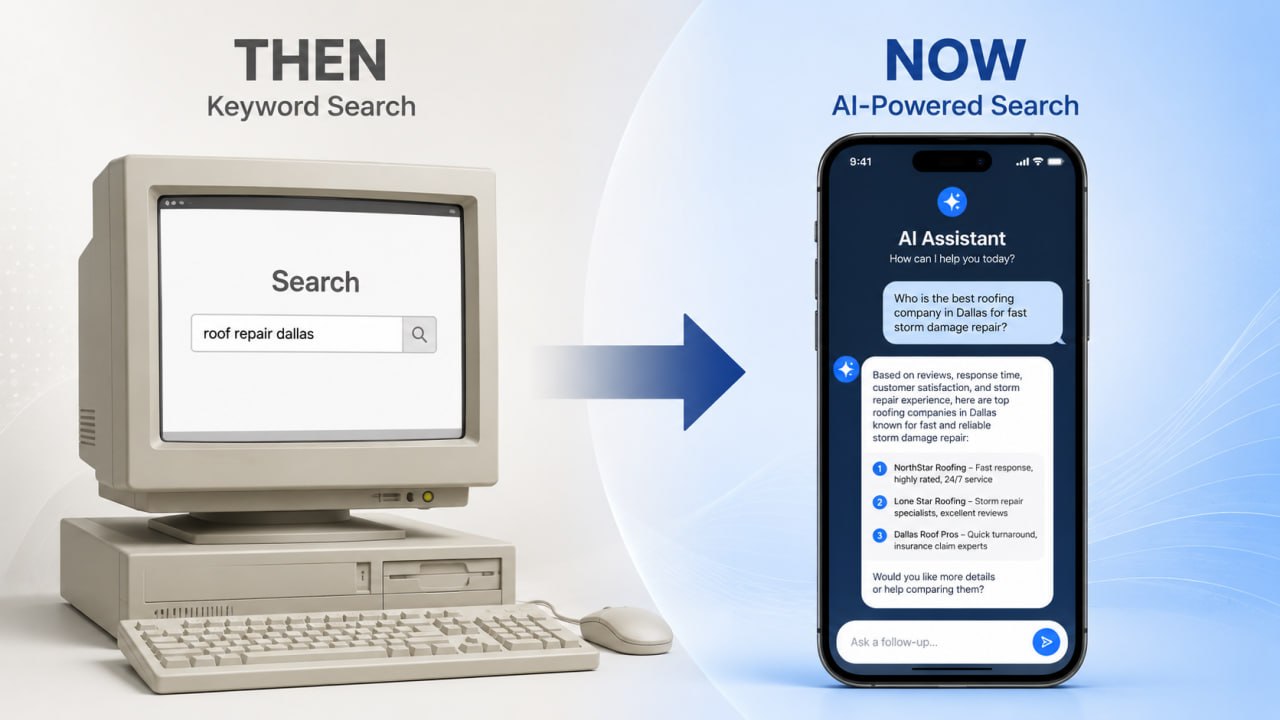
For about twenty years, the model was simple. You built a website, you ranked on Google, people clicked your link. Getting that click was the whole game.
That model started breaking down around 2019, when SparkToro first measured that roughly half of all searches ended without a click. The trend was slow and easy to ignore. Then Google introduced AI Overviews in 2024, and the numbers moved fast. Similarweb data shows zero-click searches jumped from 56% to 69% between May 2024 and May 2025, a 13-point climb in twelve months.
By early 2026, SparkToro put the number at 68%. To put that in plain terms: for every 100 people who search Google right now, 68 get their answer and leave without clicking anything. Your website traffic can drop while your rankings hold perfectly steady, because Google is answering the question before the user gets to your listing.
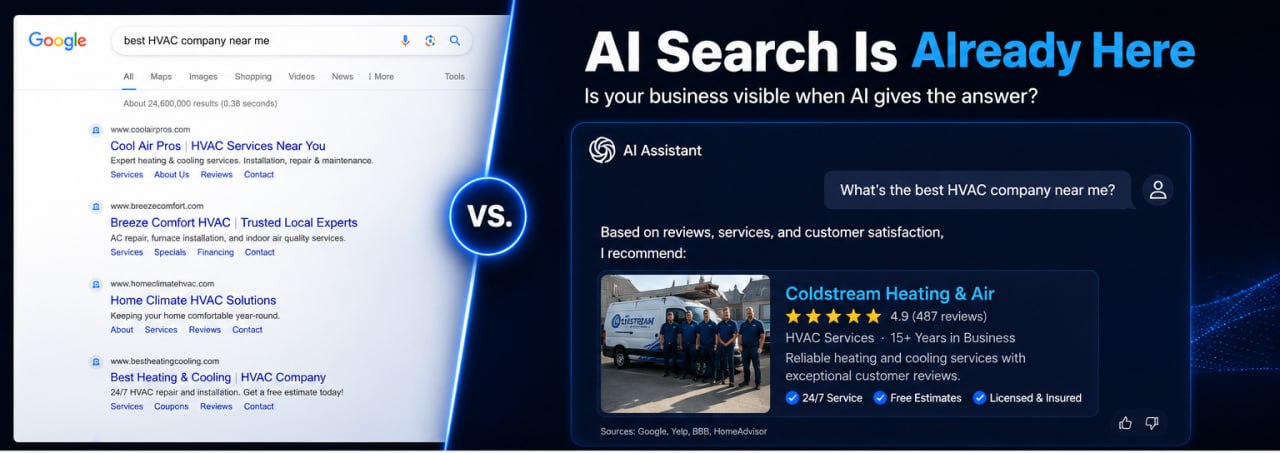
And Google is not the only place this is happening. ChatGPT, Perplexity, Gemini, and Claude are all fielding search queries. According to Similarweb data, those platforms collectively grew AI search volume by 340% year over year in Q1 2026. When someone asks ChatGPT who the best HVAC company in their city is, ChatGPT does not show a list of links. It gives one answer.
If you are not the answer it gives, you do not exist for that buyer.
What Does This Actually Look Like for a Local Business?
Let me make this concrete. Imagine a homeowner whose water heater stops working on a Saturday morning. In 2022, they would have searched Google for "water heater repair near me," scrolled through a list of links, opened three websites, and called the one that looked most trustworthy. Your website had a fighting chance.
Here is what that same buyer does today. They open ChatGPT and type: "My water heater just went out and I need someone who does emergency repairs in McKinney." ChatGPT reads its data, pulls the business that has clear, structured, factual information, and responds with a name, a phone number, and a reason to call. The buyer calls. They never visited a website. They never saw a list of search results.
Now consider the pediatric clinic scenario. A parent notices a rash on their toddler at 9 PM. They ask Perplexity: "Which pediatric clinics near me are open right now?" Perplexity scans available data and returns the clinic that publishes clear hours, services, and location information in a format AI engines can read easily. The parent calls. Again, no website visit. No link click.
This is not a future prediction. This is happening right now. And the businesses getting recommended are not necessarily the ones with the best reviews or the highest rankings. They are the ones whose online presence is readable, factual, and structured.
Why Do Some Businesses Get Picked by AI and Others Get Ignored?
The answer comes down to how your website is written. Most small business websites are built to impress human visitors. They have warm language, creative phrasing, and general positioning statements. AI bots cannot do anything with that.
Here is an example of copy that is common on small business websites: “We have been a trusted partner in our community for generations, delivering unparalleled service and peace of mind to every family we serve.” That sentence reads well to a human. An AI engine processes it and learns nothing useful. What services? What city? What hours? What makes you different from the business down the street?
Compare that to this: “Johnson Plumbing provides 24-hour emergency pipe repair, drain cleaning, and water heater installation in McKinney and Frisco, Texas. We serve residential and commercial customers and guarantee same-day response on emergency calls.” That version tells an AI engine exactly who you are, what you do, and where you work. It can match you to a buyer's specific question because the answer is right there.
The difference is not writing quality. It is specificity. AI engines match answers to questions. If your content does not clearly answer the questions buyers are asking, you will not be matched.
What Does the Data Tell Us About AI-Cited Businesses vs. Everyone Else?
The gap between businesses that show up in AI answers and those that do not is becoming significant. Seer Interactive analyzed 3,119 informational queries across 42 organizations, covering 25.1 million organic impressions from June 2024 through September 2025. Their findings are worth sitting with for a moment.
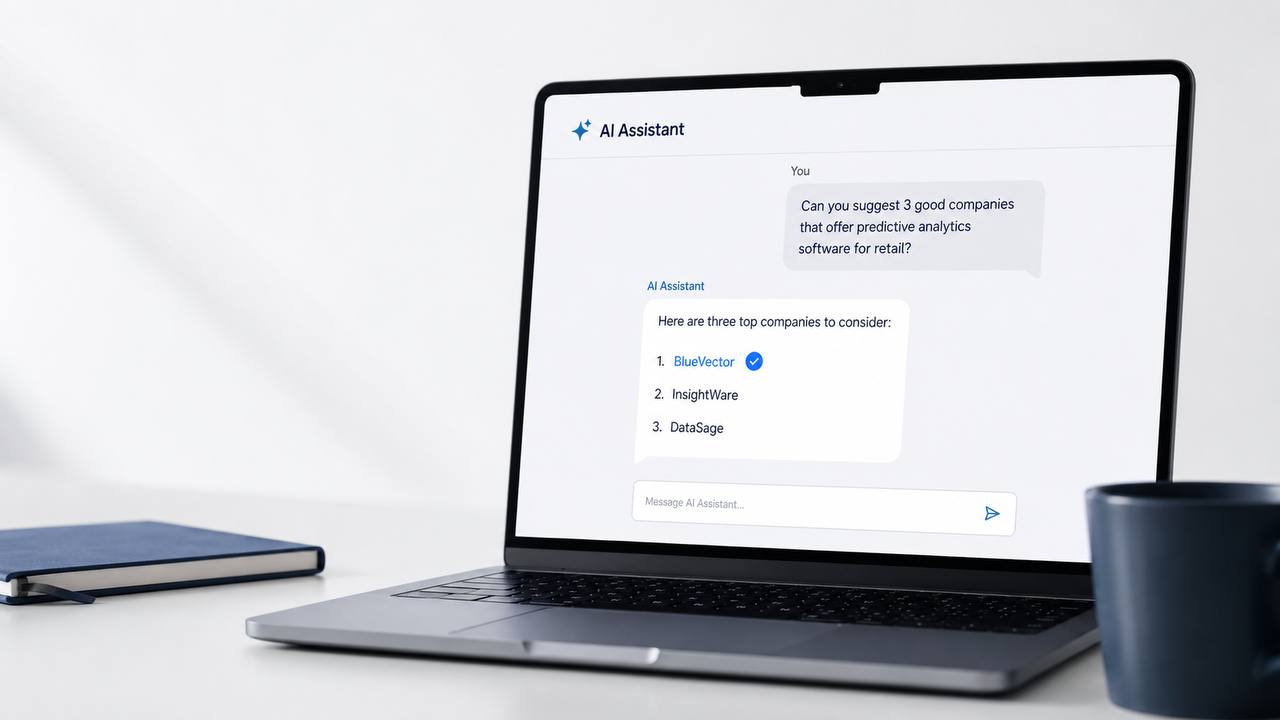
For queries where a Google AI Overview appeared, organic click-through rates dropped from 1.76% to 0.61%. That is a 61% decline. But, and this is the part most business owners miss, brands that were cited directly inside the AI Overview had a 35% higher click-through rate than brands that ranked organically but were not cited. Being in position one no longer matters as much as being cited inside the AI summary.
Put it this way: two businesses can both rank in the top three on Google. If one gets cited in the AI Overview and the other does not, the cited business gets significantly more traffic despite the same ranking. The citation is the new position one.
The Seer data also showed that brands cited in AI Overviews earned 91% more paid clicks than uncited brands on the same page. The citation advantage extends across both organic and paid performance.
| Metric | Without AI Overview | With AI Overview |
|---|---|---|
| Organic CTR | 1.76% | 0.61% (down 61%) |
| Zero-click rate | ~40% | 83% |
| Clicks for cited brands | -- | +35% vs uncited |
| Paid CTR | 19.7% | 6.34% (down 68%) |
Sources: Seer Interactive (Sept 2025); Bain/Dynata (Dec 2024); SparkToro/Similarweb (June 2026).
Should You Block AI Bots from Reading Your Website?
This question comes up regularly, and the reasoning behind it makes a surface kind of sense. If AI bots are reading your content and answering questions so users never visit your site, why give them access?
Here is the problem with that thinking. Blocking AI bots does not send buyers back to clicking links. It removes your business from the pool of options AI engines can recommend. The buyer still uses AI to search. The AI still gives one answer. That answer is now your competitor, because your competitor let the bots in.
You cannot change how buyers search. The adoption curve on AI-assisted search has been too fast and too broad. What you can change is whether your business shows up when they do.
The only productive response to this shift is to make your content easy for AI engines to read, understand, and trust. That means clear language, specific facts, structured formatting, and answers to the questions your customers actually ask.
What Specific Changes Make Your Website More Readable to AI Engines?
There are a handful of things that make the biggest practical difference. None of them require a complete website rebuild. Most require a writing change.
Use Exact Nouns and Specific Facts
AI engines match businesses to buyer questions based on specific terms. Vague positioning statements do not match anything. Replace general language with specifics: the exact services you offer, the cities you serve, the types of customers you work with, and the hours you operate.
Write Answers to Questions, Not Just Descriptions
Think about the questions your best customers ask before they call you. Write those questions on your website and answer them directly below each one. A 40-to-60-word direct answer placed under a question header is one of the highest-yield formats for AI citation. It is self-contained, clear, and extractable. AI engines can pull it and use it verbatim.
Name Your Location, Your Service, and Your Differentiator Together
The most common missed opportunity I see is businesses that name their service but not their location, or their location but not their service. AI engines need all three elements — service, location, differentiator — to match you to a specific buyer's question. A buyer asking who does same-day water heater repair in Plano needs all three of those terms present on your page to find you through an AI tool.
Keep Content Accurate and Updated
AI-cited content is on average 25.7% fresher than organically cited content. When AI engines are evaluating sources to cite, recency matters. Keep your service pages, hours, and location information accurate. Stale information hurts your credibility with AI engines the same way it hurts it with human readers.
How Do You Find Out If AI Engines Can Already See Your Business?
Most business owners have no idea whether ChatGPT, Perplexity, or Gemini would recommend them to a buyer right now. The good news is that you can find out.
Get Cited AI (getcitedai.ai) is a free tool that scans the web and checks whether major AI platforms know your business exists. It tells you how visible you are to AI engines and gives you a starting point for improving your standing.
Run the check before you assume you are covered. Most local businesses that check for the first time discover that AI engines know very little about them, even if they have a strong Google ranking and decent reviews. The content AI engines need is different from the content that earns a Google ranking, and most websites have not been updated to bridge that gap.
Frequently Asked Questions
What is a zero-click search?
A zero-click search is a web search that ends without the user clicking any link. The search engine or AI tool answers the question directly on the results screen. According to SparkToro's June 2026 research, 68% of U.S. Google searches now end this way.
Why are website clicks going down for local businesses?
Clicks are going down because AI tools and Google's own AI features now answer common questions on the results page before users need to visit a website. The decline is steepest for informational and local service queries, which are exactly the searches that drive calls and appointments for local businesses.
How do local businesses get found if clicks are disappearing?
Local businesses get found by making their content readable and useful for AI engines. That means clear, factual language; specific service and location details; direct answers to common customer questions; and accurate, updated information across all online listings.
Does Google's AI Overview affect my business if I rank on the first page?
Yes. Seer Interactive's research found that organic click-through rates dropped 61% on queries where a Google AI Overview appeared, even for pages ranking in the top positions. Ranking high is no longer enough. Being cited inside the AI summary is what drives traffic now.
Will standard search engines go away completely?
No. Search engines are not disappearing, but they are becoming answer engines. Most informational queries are now answered on the results page without sending traffic to any website. The businesses that adapt their content for this environment will stay visible. The ones that do not will see steady traffic declines regardless of their rankings.
What is the 40-to-60 word rule for website content?
The 40-to-60 word rule means placing a short, direct answer immediately below a question header on your web pages. That format is easily extracted by AI engines and used as a cited response. It is one of the most practical structural changes a local business can make to improve AI visibility.
Should I block AI bots to force people back to my website?
No. Blocking AI bots does not return buyers to link-clicking behavior. It removes your business from AI recommendations entirely. The buyer still uses AI to search. Your competitor, who allowed bots access, gets the recommendation instead.
How do I know if AI engines can see my business right now?
Run a free AI visibility check at getcitedai.ai. The tool scans major AI platforms including ChatGPT, Perplexity, and Gemini to tell you whether they know your business exists and what they know about it.
Final Thoughts
Here is what I have seen over forty years of marketing work. The businesses that survive major shifts in how buyers find them are the ones that adapt early, not the ones that wait for certainty.
Zero-click search is not a fringe concern for digital marketers. It is the defining structural shift in how local buyers find service providers right now. The data is consistent across multiple independent research sources. SparkToro, Seer Interactive, Bain, and Pew Research all point in the same direction: AI is answering questions that used to send traffic to your website, and the businesses being recommended are the ones with clear, factual, structured content.
The practical path forward is not complicated. Write content that answers real questions. Name your services, your location, and what makes you different in plain language. Update your information regularly. And find out where you stand before you assume you are covered.
Start with a free AI visibility check.
Know the number. Then make a decision about what to do next.
About the Author
Mark Toney is the founder and CEO of Luce Media, a McKinney, Texas-based marketing agency with over eleven years of experience helping businesses grow through strategy-led marketing. He serves as a fractional CMO for B2B companies and is the creator of Get Cited AI (getcitedai.ai), a tool that helps local businesses measure and improve their visibility with AI-powered search engines. Mark has over 40 years of marketing and executive leadership experience across manufacturing, healthcare, dental, fintech, and professional services.
E-E-A-T credentials: Verified marketing practitioner with documented client outcomes including $4.21M attributable revenue for Goelzer Industries and patient growth from 70 to 175+ per month for Elite Health Online.