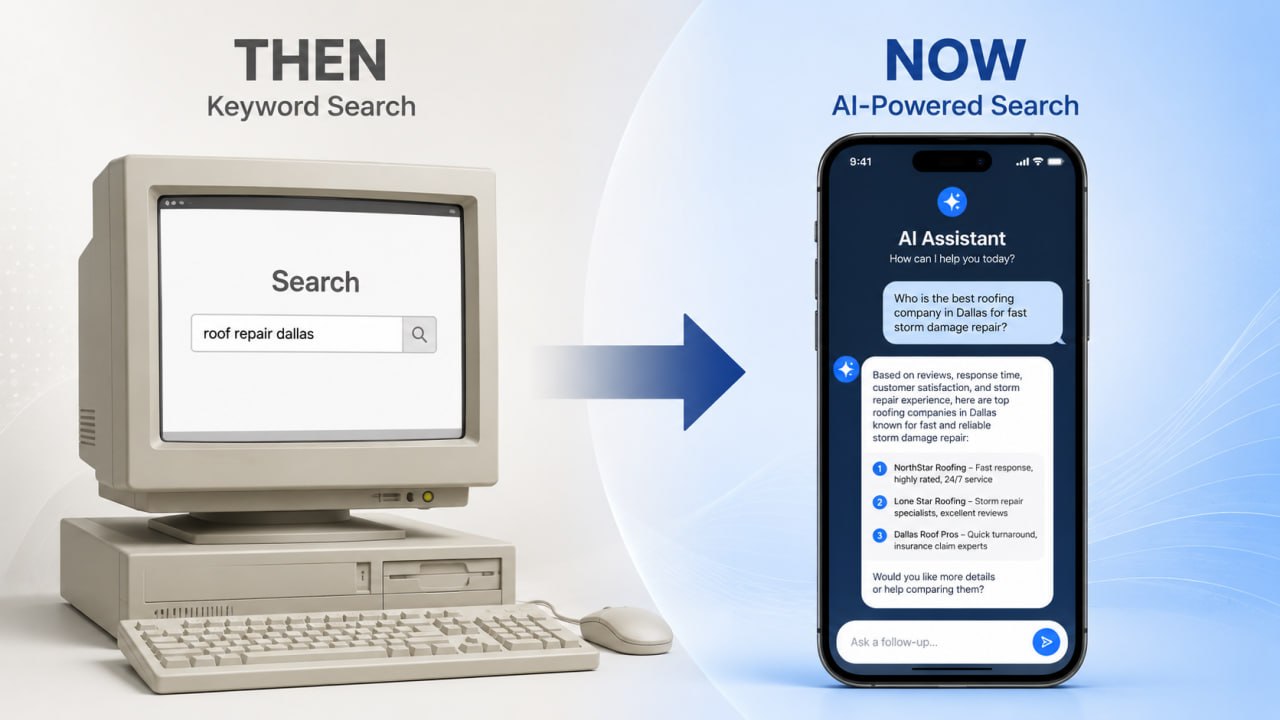
Most businesses still think visibility means rankings, traffic, and clicks. That is no longer the whole job. Buyers are now asking ChatGPT, Gemini, Perplexity, and Google AI for direct answers, which means the winners are not just ranking pages. They are becoming the source answer engines trust enough to cite.
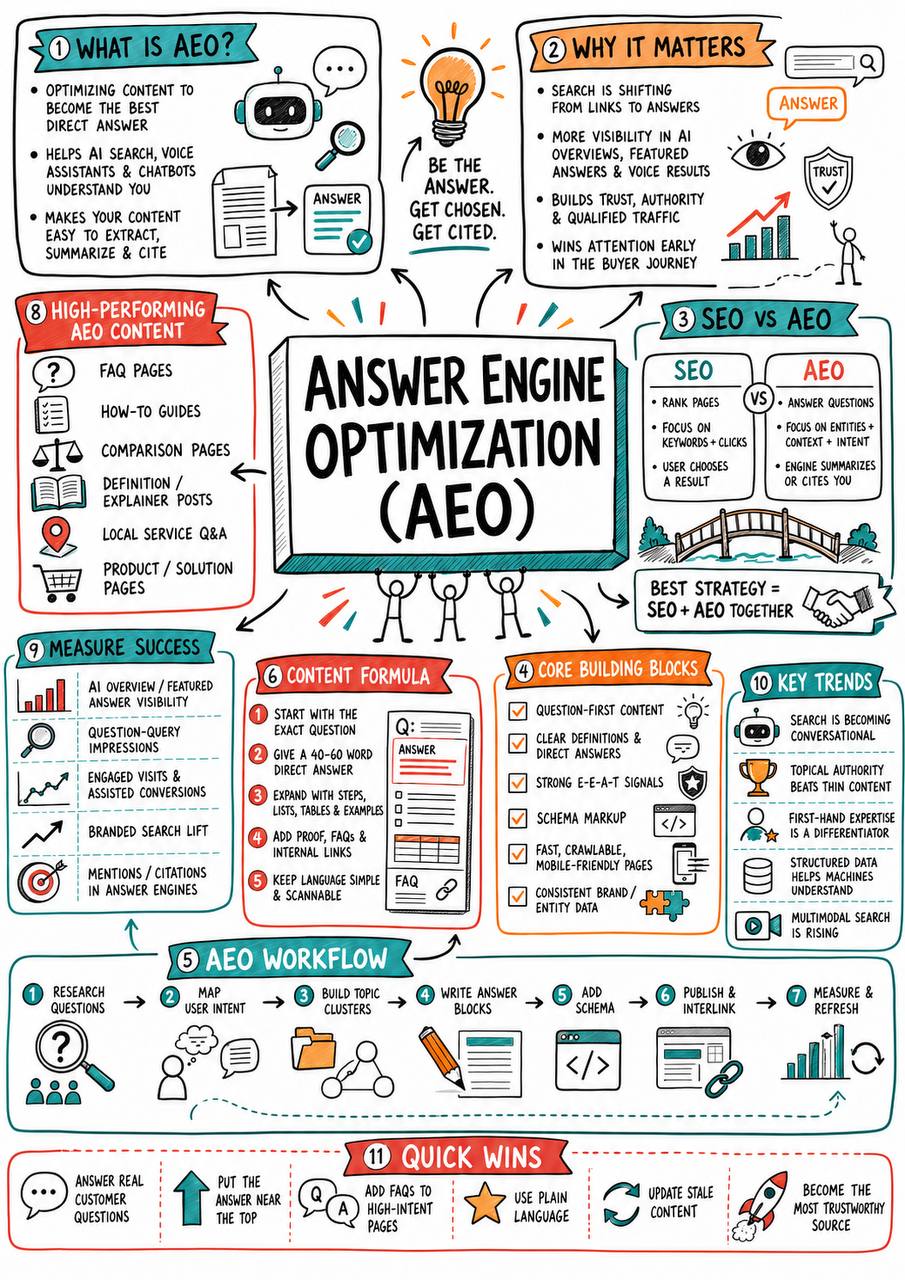
This post turns the Get Cited AI infographic into a practical guide you can actually use. It walks through the core AEO sections one by one, explains what they mean in plain English, and shows how the Get Cited AI Done For You service at $497 helps businesses install this visibility layer without turning it into another internal project.
The fast answer
Answer Engine Optimization is the process of making your content easier for AI systems to understand, extract, summarize, and cite. If SEO helps you rank, AEO helps you become the answer that gets chosen, trusted, and recommended when buyers ask direct questions.
1. What is answer engine optimization?
Answer Engine Optimization is the process of structuring content and technical signals so AI systems can understand, extract, summarize, and cite your business when users ask direct questions. The goal is not only ranking a page. The goal is becoming the clearest, most trustworthy answer source on the topic.
That matters because answer engines do not behave like classic search results. They compress discovery, summarize what they see, and often form a recommendation before the user ever visits your site. If your pages are vague, scattered, or hard to interpret, they may never make the shortlist.
2. Why does AEO matter now?
AEO matters because search is shifting from lists of links toward direct answers, AI Overviews, cited summaries, and assistant-style recommendations. If your site is not built for those environments, you can lose visibility early in the buyer journey even when your traditional SEO foundation is respectable.
This is why AEO is not just a content trend. It is a visibility shift. Buyers are using AI to understand categories, compare vendors, clarify terminology, and narrow options. That means more business discovery happens before the click, not just after it.
3. What is the difference between SEO and AEO?
SEO helps pages rank in traditional search. AEO helps answer engines interpret, summarize, and cite the right parts of your business when users ask direct questions. The smartest strategy is not choosing one over the other. It is building SEO and AEO together so both discovery environments work in your favor.
Primary objective
SEO
Rank pages, earn organic traffic, and capture qualified clicks from traditional search results.
AEO
Become the answer, citation, or recommendation that AI systems surface before the click.
Optimization target
SEO
Keywords, rankings, site authority, technical health, and click-through performance.
AEO
Questions, entities, context, answer formatting, and machine-readable clarity.
User experience
SEO
The user chooses a result from a list of links and then decides what to read.
AEO
The engine often summarizes, cites, or recommends a source directly inside the answer layer.
Best content shape
SEO
Pages designed to match search demand, cover topics deeply, and win relevance signals.
AEO
Direct answers, definitions, FAQs, comparisons, and structured facts that can be extracted cleanly.
Best strategy
SEO
Build the strongest possible discoverability and authority foundation.
AEO
Add the answer-ready technical and content layer that helps AI systems interpret that foundation.
| Comparison point | SEO | AEO |
|---|---|---|
| Primary objective | Rank pages, earn organic traffic, and capture qualified clicks from traditional search results. | Become the answer, citation, or recommendation that AI systems surface before the click. |
| Optimization target | Keywords, rankings, site authority, technical health, and click-through performance. | Questions, entities, context, answer formatting, and machine-readable clarity. |
| User experience | The user chooses a result from a list of links and then decides what to read. | The engine often summarizes, cites, or recommends a source directly inside the answer layer. |
| Best content shape | Pages designed to match search demand, cover topics deeply, and win relevance signals. | Direct answers, definitions, FAQs, comparisons, and structured facts that can be extracted cleanly. |
| Best strategy | Build the strongest possible discoverability and authority foundation. | Add the answer-ready technical and content layer that helps AI systems interpret that foundation. |
If you want the deeper comparison, read our full AEO vs SEO guide. It breaks down the overlap and the differences in more detail. The short version is that SEO gets you found, while AEO helps answer engines understand what to do with what they find.
4. What are the core building blocks of AEO?
The core building blocks of AEO are question-first content, direct answers, strong trust signals, schema markup, fast and crawlable pages, and consistent entity data. These elements work together to reduce ambiguity so machines can understand what your business does and why it should be trusted.
Question-first content
Start with what buyers actually ask, not what your team wishes they searched. AEO begins with real question demand.
Clear definitions and direct answers
Give the answer early and clearly. If the first useful sentence is buried, both users and machines lose confidence fast.
Strong E-E-A-T signals
Pages need visible expertise, proof, authorship, and trust markers so AI systems have stronger reasons to treat you as credible.
Schema markup
Structured data turns page meaning into machine-readable context, which helps answer engines reduce ambiguity around your business.
Fast, crawlable, mobile-friendly pages
If pages are hard to load, parse, or navigate, the answer layer suffers because your content is harder to understand at scale.
Consistent brand and entity data
Your organization, services, locations, and authority signals need to align across core pages so AI tools can classify you correctly.
Most businesses are missing more than one of these pieces. They may have decent content but weak structure. They may have technical SEO but thin definitions. They may have authority but inconsistent service language. Get Cited AI is built to close those gaps quickly instead of treating them as separate projects.
5. What does an effective AEO workflow look like?
An effective AEO workflow starts with real buyer questions, maps them to intent, builds connected topic clusters, creates direct answer blocks, adds schema and structured meaning, then measures what answer engines actually surface. The process is not guesswork. It is structured visibility engineering.
Step 1
Research the exact questions your buyers ask across search and sales conversations.
Step 2
Map user intent so each question connects to the right page type and stage of the journey.
Step 3
Build topic clusters that create context instead of isolated content fragments.
Step 4
Write direct answer blocks that are easy to quote, summarize, and trust.
Step 5
Add schema and other machine-readable signals that clarify the meaning of the page.
Step 6
Publish and interlink related pages so authority and context reinforce each other.
Step 7
Measure visibility, citations, and assisted conversions, then refresh stale pages before they decay.
The reason this workflow matters is simple: AEO is cumulative. One definition page helps. One FAQ section helps. But the bigger gain comes when your pages reinforce each other, your schema lines up with the visible content, and your internal links create stronger topic context across the site.
6. What is the best content formula for AEO?
The best AEO content formula is simple: start with the exact question, answer it directly in 40 to 60 words, then expand with steps, examples, proof, FAQs, and internal links. That structure gives humans clarity and gives answer engines a clean block of content they can extract or summarize accurately.
Formula 1
Start with the exact question the audience is asking.
Formula 2
Answer it directly in 40 to 60 words near the top of the section.
Formula 3
Expand with steps, lists, tables, examples, and context that make the answer more useful.
Formula 4
Add proof, FAQs, and internal links that strengthen trust and topic depth.
Formula 5
Keep the language plain, specific, and easy for both humans and machines to scan.
This is one reason generic blog writing underperforms in answer engines. Many posts take too long to get to the point, bury the definition under filler, or use vague language that sounds polished but says very little. AEO rewards useful structure over performative content.
7. Which types of content perform best for AEO?
FAQ pages, how-to guides, comparison pages, explainer posts, local service Q-and-A pages, and product or solution pages usually perform best for AEO. They match the formats answer engines prefer because they are easier to quote, easier to structure, and easier to connect to a clear user intent.
FAQ pages
They mirror how users phrase questions and give answer engines clean question-and-answer pairs to extract.
How-to guides
They work well when buyers need a process, a checklist, or a sequence of steps tied to a practical goal.
Comparison pages
They help AI systems explain tradeoffs clearly, which is especially useful when buyers are evaluating options or categories.
Definition and explainer posts
They establish topical authority and give AI tools a strong source for foundational concepts that need concise explanations.
Local service Q&A
These pages help when users ask location-based service questions and need a business or provider recommendation.
Product and solution pages
When structured properly, they turn commercial intent into clear answers about fit, use case, and differentiation.
The important point is not to publish all of these at once. It is to prioritize the page types that sit closest to buyer intent and commercial decision-making, then improve them in the order that gives your business the fastest visibility lift.
8. How do you measure AEO success?
AEO success is measured by more than rankings. You need to watch AI Overview and answer visibility, question-query impressions, engaged visits, assisted conversions, branded search lift, and whether your business is being mentioned or cited in answer engines for the queries that matter most.
Signal 1
AI Overview and featured-answer visibility for priority questions.
Signal 2
Question-query impressions and engagement from intent-driven content.
Signal 3
Engaged visits and assisted conversions influenced by answer-first discovery.
Signal 4
Branded search lift as buyers remember and verify your company after AI exposure.
Signal 5
Mentions and citations in answer engines, especially for commercial and comparison queries.
This is why a visibility baseline matters. Without one, businesses end up guessing whether they are improving. Get Cited AI starts with the baseline so you can see what is missing before more time gets spent on disconnected activity.
9. What trends are shaping AEO right now?
AEO is being shaped by conversational search, rising demand for topical authority, a stronger premium on first-hand expertise, greater value from structured data, and growing multimodal behavior. In plain terms, the answer layer is rewarding businesses that are easier to understand and harder to confuse.
Trend 1
Search is becoming more conversational, which raises the value of natural language questions and direct answers.
Trend 2
Topical authority is beating thin content because AI systems need context, not just isolated pages.
Trend 3
First-hand expertise is becoming a differentiator when generic summaries are everywhere.
Trend 4
Structured data keeps gaining importance because it helps machines interpret page meaning faster and more accurately.
Trend 5
Multimodal search is rising, which means pages, images, diagrams, and supporting visuals all matter more now.
The businesses that benefit most will not necessarily be the loudest. They will be the clearest. In a market full of thin summaries and recycled content, clear expertise and strong structure become strategic advantages.
10. What quick wins improve AEO fastest?
The fastest AEO wins usually come from answering real customer questions, moving the answer higher on the page, adding FAQs to high-intent content, simplifying language, refreshing stale pages, and strengthening trust signals. These are practical changes that improve extractability without requiring a full site rebuild first.
Quick win 1
Answer the real questions customers ask in calls, meetings, demos, and intake forms.
Quick win 2
Put the direct answer near the top instead of hiding it under long introductions.
Quick win 3
Add visible FAQs to high-intent pages where buyers need clarity before taking action.
Quick win 4
Use plain language that reduces ambiguity and sounds like a confident operator, not a jargon generator.
Quick win 5
Refresh stale content so older pages do not send outdated or confusing signals to answer engines.
Quick win 6
Aim to become the most trustworthy source on the question, not just another page that mentions it.
If you want a practical next step after this guide, spend time on the Get Cited AI Resources page. It will help you see how answer engines score your visibility and where the missing signals usually show up.
How does Get Cited AI apply this without turning it into another internal project?
Get Cited AI applies these AEO principles by installing the foundational visibility layer that many businesses do not have time or internal expertise to build correctly. The Done For You service at $497 handles core issues such as schema markup, llms.txt, ai.txt, entity clarity, and answer-ready structure across your key pages.
That does not replace your broader marketing strategy. It strengthens it. If you already have SEO work underway, AEO helps carry that investment into AI-driven discovery. If you do not, it gives you a cleaner starting point so future content and visibility work have a better chance of compounding.
What should you do next if you want stronger AEO?
Start by measuring the gap instead of guessing. Review the AEO vs SEO comparison, use the Resources page to understand the visibility signals that matter, and then run the audit so you know where your site is weak.
If you want the Done For You version, Get Cited AI installs the practical AEO layer for $497 so your business is easier for AI systems to understand, trust, and recommend. That is the fastest way to move from theory to implementation.
Frequently Asked Questions About Answer Engine Optimization
What is answer engine optimization?
Answer Engine Optimization is the process of structuring content and technical signals so AI systems can understand, extract, summarize, and cite your business when users ask direct questions. It builds on SEO, but it is designed for answer engines rather than only classic search result pages.
Is AEO replacing SEO?
No. AEO is not replacing SEO. Strong SEO still gives your site crawlability, relevance, authority, and discoverability. AEO adds the extra machine-readable clarity and answer formatting that help AI tools decide whether your business should be quoted or recommended.
Do I need schema markup for AEO?
Schema markup is one of the clearest technical signals for AEO because it helps machines interpret page purpose, organization details, services, FAQs, and other structured facts. It is not the only requirement, but it is part of the core visibility layer most businesses are missing.
What pages should I optimize first for AEO?
Start with high-intent pages that define your company, services, locations, credibility, and core buyer questions. In most cases that means your home page, service pages, comparison pages, FAQ content, and any page that supports how buyers and AI systems classify your business.
What is the ideal format for AEO content?
The strongest AEO content usually starts with the exact question, follows with a 40 to 60 word direct answer, and then expands with steps, examples, tables, FAQs, and internal links. The structure needs to work for both human readers and machine extraction.
How does Get Cited AI help with AEO?
Get Cited AI identifies the gaps that keep businesses from being cited or recommended by AI tools, then installs the core answer-engine visibility layer. The Done For You service at $497 handles foundational work such as schema, llms.txt, ai.txt, entity clarity, and answer-ready page improvements.