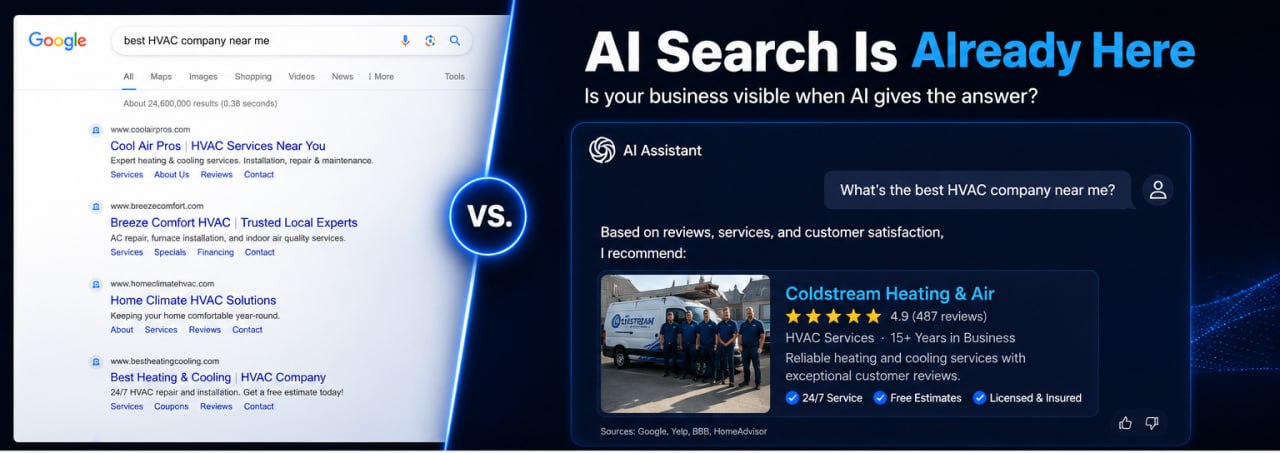
Quick Answer
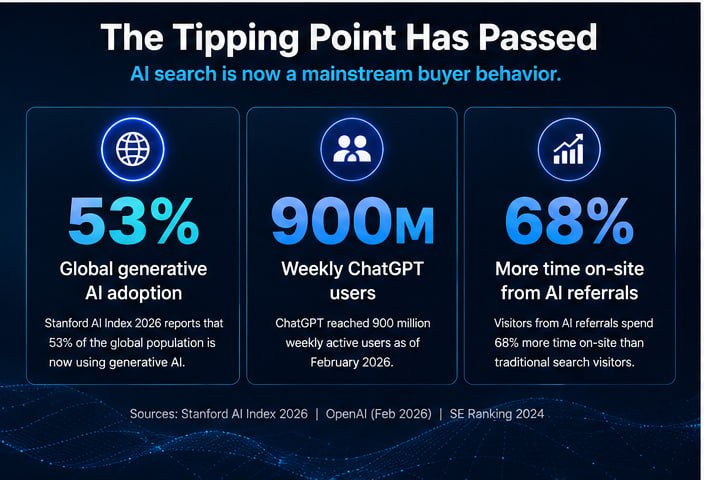
AI search adoption has already crossed the mass adoption threshold. The Stanford 2026 AI Index reports that generative AI tools reached 53% population adoption globally, faster than either the personal computer or the internet. ChatGPT alone now serves more than 900 million weekly active users. The businesses showing up in AI-generated answers today are building a trust history that competitors cannot easily erase later. If your business is not structured for AI visibility right now, you are not waiting for a wave. The wave has already passed through.
Introduction
AI search adoption for small businesses is no longer a future planning problem. It is a current competitive reality.
I have spent over 40 years helping CEOs understand where their real growth constraints live. Most of the time, the problem is not what they think it is. Right now, I am watching a version of that play out in the digital marketing world. Business owners are still preparing for an AI-driven search shift that, by most available measures, has already happened.
The Stanford Human-Centered Artificial Intelligence Institute published its 2026 AI Index Report in April of this year. The number that deserves your attention is this: generative AI tools reached 53% adoption among the global population within three years of ChatGPT's launch. That is faster than either the personal computer or the internet reached comparable levels. The threshold was not mid-2026. The threshold is behind us.
This post explains what that means for your local business, why timing inside AI systems is structurally different from traditional search, and what you can do about it today.
Key Takeaways
- Generative AI has already passed the 20% global adoption threshold. Stanford's 2026 AI Index puts it at 53%.
- ChatGPT reached 900 million weekly active users as of February 2026, confirmed by OpenAI. That is more than double the user count from one year earlier.
- AI engines do not rank businesses. They cite businesses. The criteria are different, and most business websites are not built to meet them.
- Business legibility, how clearly an AI system can read and verify what you do, is the new currency of digital visibility.
- Trust inside AI systems is built over time through structured, consistent, verifiable data. You cannot buy your way in overnight.
- Gartner predicts that traditional search engine volume will drop 25% by 2026 as users shift to AI assistants.
What Is the Mass Adoption Threshold and Has AI Already Crossed It?
The mass adoption threshold is the point where a new technology becomes part of normal daily life for at least 20% of the population. Once a technology crosses that line, businesses that have not adapted begin losing ground in ways that are hard to reverse.
Generative AI crossed that threshold a long time ago.
The Stanford 2026 AI Index, published April 2026, reports that generative AI reached 53% population adoption globally within three years of ChatGPT's launch. That is faster than the personal computer and faster than the internet.
Separately, OpenAI confirmed in February 2026 that ChatGPT alone had reached 900 million weekly active users, up from 400 million just 12 months earlier. That is a 125% year-over-year increase, confirmed by Reuters.
So when someone tells you AI search is coming and you need to prepare, the framing is already wrong. This is not about preparation. It is about catching up.
Traditional Search vs. AI Search: How the Rules Changed
| Factor | Traditional Search (Google) | AI Search (ChatGPT, Perplexity, Gemini) |
|---|---|---|
| Primary goal | Rank high on page one | Be cited in the answer |
| How users find you | Click on a search result | AI recommends you by name |
| What earns visibility | Keywords, backlinks, domain authority | Structured data, verified identity, legibility |
| Trust is built by | Volume of links and content | Consistent, verifiable data over time |
| Speed to catch up | Possible with effort and budget | Very difficult once competitors own the history |
What Does AI Search Adoption Actually Mean for a Local Business?
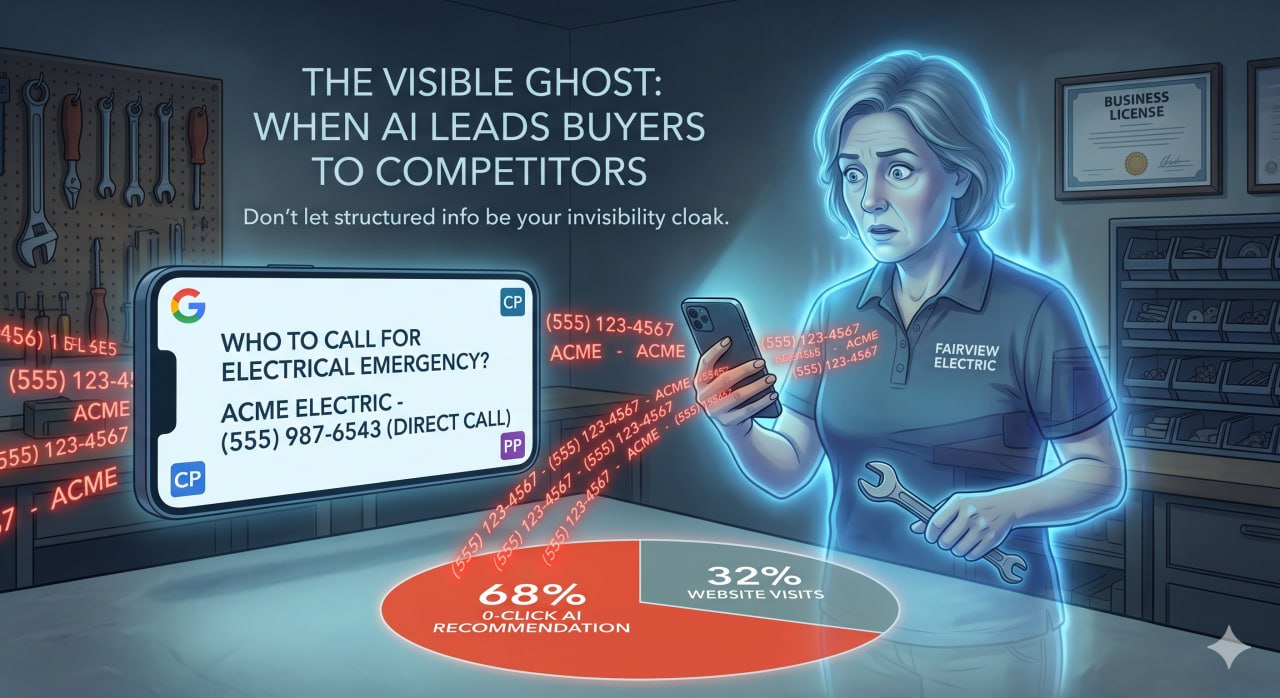
It means the shortlist is getting shorter, and your name may not be on it.
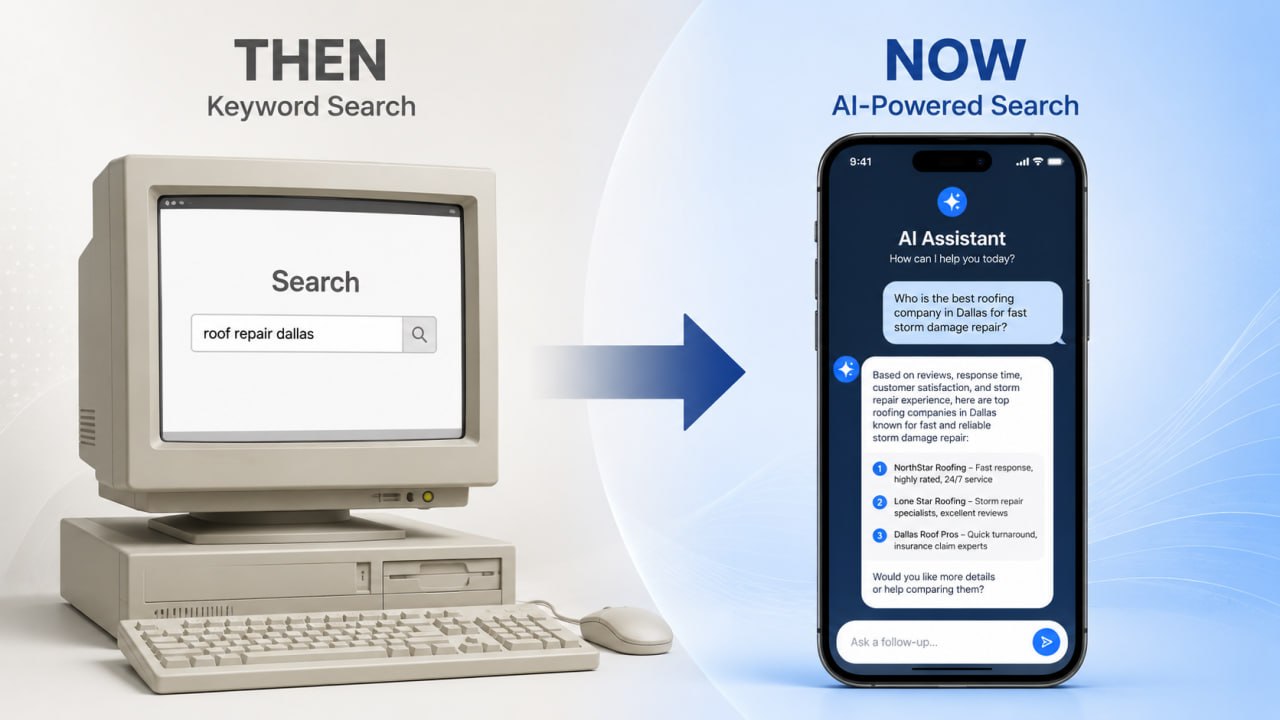
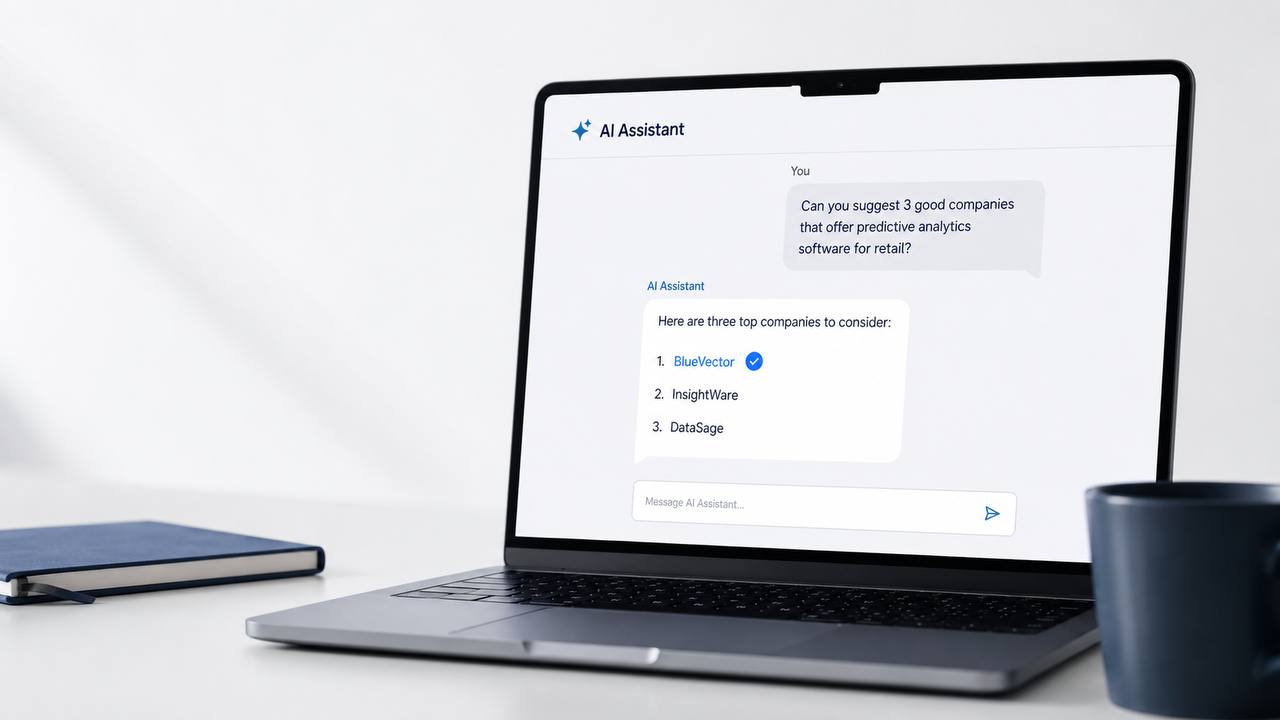
Think about how people use ChatGPT or Perplexity today. They do not type a search term and scroll through ten blue links. They ask a question and get an answer. That answer usually includes one to three specific recommendations.
If your business is not structured so that an AI engine can read and verify what you do, who you serve, and why you are credible, you will not appear in that answer. The AI system will not skip you with malicious intent. It will skip you because it cannot find what it needs fast enough. It will move on to a competitor that made it easy.
I worked with a manufacturing company called Goelzer Industries that had been in business for 38 years. They had never run social media, never sent email, never run any ads. They relied entirely on referrals. When the CEO started feeling the pain of declining sales, he knew something had to change but could not identify what. The problem was not the product. The problem was that nobody outside their existing circle could verify they existed and were credible.
That is what is happening to thousands of local businesses right now with AI search. Not because the business is bad. Because the AI engine cannot read you clearly enough to recommend you.
Gartner predicts that by 2026, traditional search engine volume will drop 25% as users shift to AI assistants. That projection was made before the current adoption numbers were confirmed. Given that generative AI is already at 53% global population adoption, the shift is likely accelerating faster than that forecast.
What Is Business Legibility and Why Does It Matter for AI Visibility?
Business legibility is how clearly an AI system can read a website to determine what a company does, who it serves, and why it should be trusted as a source or recommendation.
This is different from traditional SEO. In search engine optimization, you were competing for keyword rankings. In AI visibility, you are competing to be understood. The two problems require different solutions.
An AI engine evaluating your business is doing something closer to what a due diligence analyst does. It reads your website copy for clarity. It checks whether your business name, address, and phone number are consistent across the web. It evaluates your reviews to understand how customers describe the experience of working with you. It looks for credentials, certifications, and authority signals that verify your expertise. If it finds contradictions, gaps, or vague language, it moves on.
Most local business websites fail the legibility test immediately. Not because the owner is not capable. Because nobody built the site with an AI reader in mind.
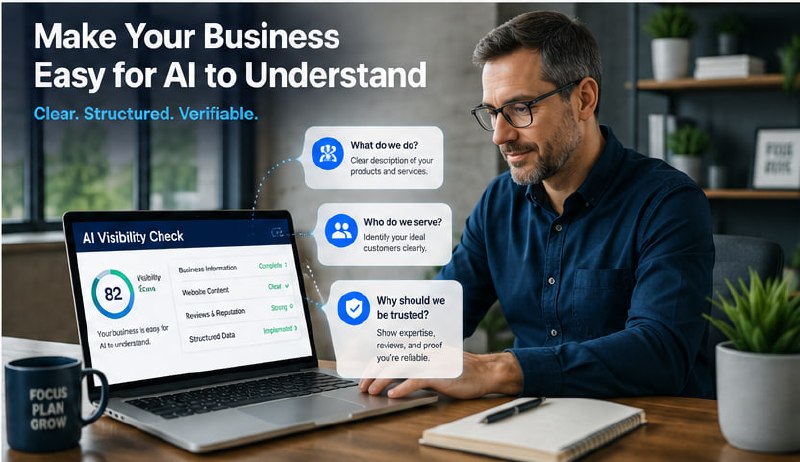
The Three Legibility Questions Every AI Engine Is Asking
- What does this business actually do? Not in marketing language. In plain terms an AI can extract and relay to a user.
- Who does this business serve? Specifically. Not everyone or all sizes. That answer is not extractable.
- Why should this business be trusted to provide a solution? What evidence exists that they have done this before and done it well?
If your website answers those three questions clearly and consistently, you have a real shot at AI visibility. If it does not, the AI will find someone whose site does.
Why Does Timing Inside AI Systems Work Differently Than Traditional Search?
AI systems carry memory. That is the thing most business owners do not understand, and it changes the competitive math entirely.
When an AI crawler visits your site and finds organized, accurate, consistently structured information, it begins building a data profile of your business. When it returns next month and finds the same quality of data, the trust level goes up. This process compounds over time.
Traditional search rankings could shift week to week based on new content or backlinks. You could run an aggressive campaign and move up the results page in 60 to 90 days. AI trust building does not work that way. There is no campaign you can run to manufacture a 12-month data history in 30 days. The time is the asset.
This is why every month you wait is a real cost. Not a vague strategic cost. A concrete one. A competitor who started building their AI visibility profile six months ago now has six months of verified, consistent data that an AI engine has been learning from. You cannot buy that. You can only start building it today and wait for the clock to run.
SparkToro research from January 2026 found that 44.2% of all LLM citations come from the first 30% of a piece of content. That means the businesses that get structured fast get cited more. The structural advantage is not small.
What Are the Real-World Consequences of Missing the AI Search Window?
The consequences are specific and they hit hardest in high-stakes, time-sensitive moments.
Think about a local roofing company after a hailstorm. In the past, they would get calls from homeowners who found them on Google or through a neighbor's referral. Today, a homeowner who uses AI tools as their primary search behavior is going to ask ChatGPT or Perplexity who the best roofing companies in their area are. If the roofing company is not structured for AI visibility, it will not appear in the answer. The company will miss the storm rush entirely, and the window for that customer may never reopen.
The same logic applies to medical practices, home services, legal services, and any other local business category where someone needs a recommendation right now. The AI gives them a short list. You are either on it or you are not.
Research from SE Ranking found that visitors referred by AI search platforms spend 68% more time on-site than visitors from traditional organic search. These are not casual browsers. They have already been pre-qualified by an AI recommendation. The lead quality is meaningfully higher, which makes the cost of being absent from AI recommendations meaningfully higher too.
How Do You Start Building AI Visibility for a Local Business?
Most business owners have no idea whether they appear in AI-generated answers for their category and location. They assume that because they rank on Google, they are visible. That assumption is increasingly wrong. Google rankings and AI visibility are not the same thing, and they are built through different mechanisms.
Here is what you can do right now:
- Run a free AI visibility check at getcitedai.ai. It takes less than a minute and shows you whether your business appears when AI tools are asked about your category.
- Audit your website for legibility. Ask whether a reader with no prior knowledge of your business could, in 30 seconds, clearly state what you do, who you serve, and why you are qualified. If the answer is no, the AI engine is having the same problem.
- Check your NAP consistency. Your business name, address, and phone number must be identical across your website, Google Business Profile, Yelp, and any other directory where you appear. Inconsistencies erode AI trust signals.
- Start building structured content. Every piece of content on your site should answer a specific question in a clear, direct way. AI engines cite the most direct, verifiable answers. Give them something worth citing.
- Do not wait for a more convenient time. The data history you build starting today is an asset. The data history you do not build is a gap your competitors are filling.
Frequently Asked Questions
Has AI search adoption already crossed the mainstream threshold?
Yes. The Stanford 2026 AI Index reports that generative AI tools reached 53% global population adoption within three years of ChatGPT's public launch. The commonly cited 20% mass adoption threshold was crossed well before mid-2026.
How many people use ChatGPT every week?
As of February 2026, OpenAI confirmed that ChatGPT reached 900 million weekly active users, more than double the 400 million reported in February 2025. Reuters also reported in June 2026 that the ChatGPT app crossed 1 billion monthly active users.
What is AI search and how is it different from Google search?
AI search refers to the use of large language models like ChatGPT, Perplexity, Gemini, and Claude to answer questions and provide recommendations. Unlike Google, which returns a list of links for users to evaluate, AI search returns a direct answer that typically names specific businesses or sources. You either appear in the answer or you do not.
What is business legibility for AI engines?
Business legibility is how clearly an AI system can read a website to determine what a company does, who it serves, and why it should be trusted. If your website uses vague language, inconsistent information, or lacks verifiable credentials, AI engines will skip you in favor of a business that made their information easier to process.
Can a business build AI visibility quickly?
You can take steps immediately, but building a trusted data history inside AI systems takes time. AI engines value consistency and accuracy over time, which means the work you start today begins compounding right away. What you cannot replicate is a competitor's head start. That history gap is real and it grows every month you wait.
What happens to traditional Google SEO as AI search grows?
Gartner predicts that traditional search volume will drop 25% by 2026 as users shift to AI assistants. This does not mean Google disappears. It means that Google and AI search are separate channels that require separate visibility strategies. A business relying only on Google SEO is already underinvested in where buyer behavior is moving.
How do AI search visitors compare to Google search visitors?
Research from SE Ranking found that visitors referred by AI platforms spend 68% more time on-site compared to visitors from traditional organic search. They arrive with higher intent because the AI has already qualified the match between their question and your business. That makes the cost of AI invisibility higher than most business owners currently estimate.
Where can I check my current AI visibility for free?
You can run a free AI visibility check at getcitedai.ai. The tool shows you whether your business appears in AI-generated answers for your category and location. It takes less than a minute.
Final Thoughts
The businesses that are going to own AI search visibility in the next 36 months are not the ones who wait to see how this plays out. They are the ones building structured, legible, verifiable business profiles right now, while most of their competitors are still talking about preparation.
I have watched this pattern play out across multiple technology shifts in my 40 years of marketing work. The window for first-mover advantage is real and it closes. The companies that move early build trust histories that later entrants cannot easily overcome. The companies that wait often find they are catching up from a position of structural disadvantage.
AI search is not coming. It is here. The question is not whether your business needs to be visible inside AI systems. The question is how much longer you want to let the gap grow.
Run your free AI visibility check at getcitedai.ai. Know where you stand before your competitors find out for you.
About the Author
Mark Toney is the founder of Luce Media, an 11-year-old marketing advisory firm based in McKinney, Texas. He has more than 40 years of marketing and executive leadership experience and has served as fractional CMO for companies in manufacturing, healthcare, dental, fintech, and commercial print. He is the creator of Get Cited AI, a tool that helps local businesses measure and improve their visibility inside AI-generated search answers. His documented client results include $4.21M in attributable revenue for Goelzer Industries.