Quick Answer
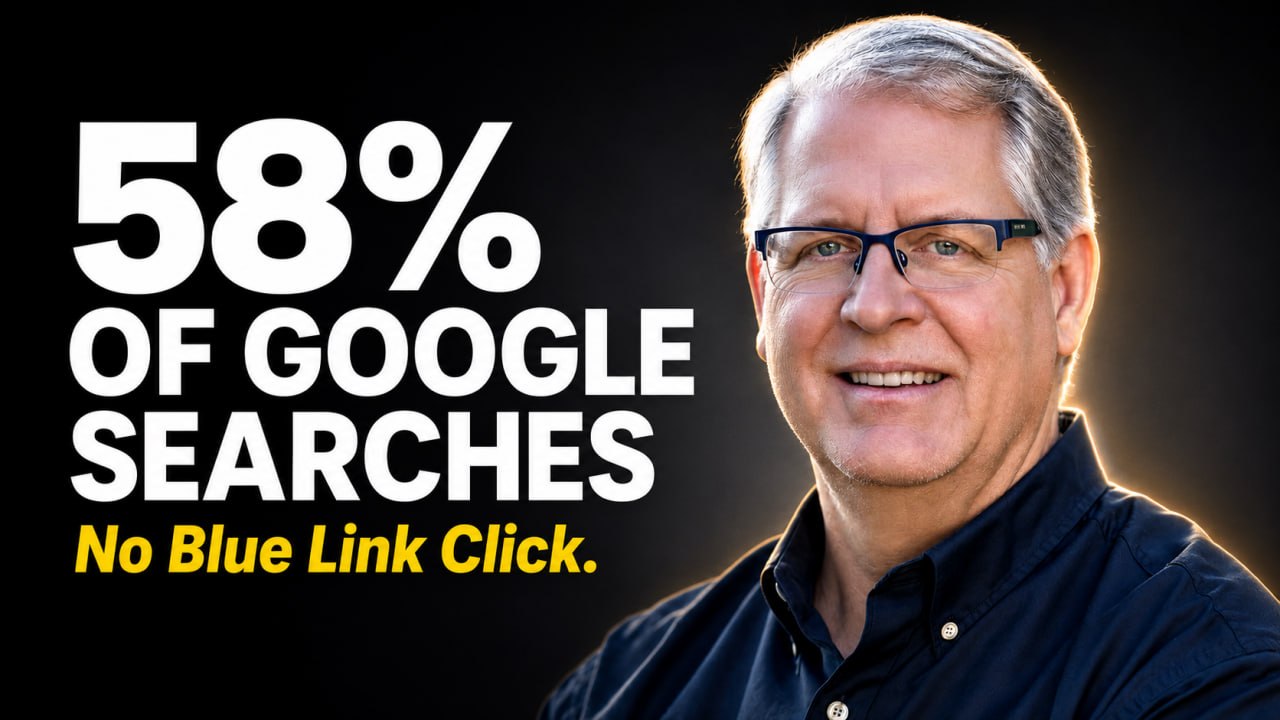
How customers search with AI has fundamentally changed. According to OpenAI's September 2025 study of 1.5 million conversations, nearly half (49%) of all ChatGPT messages fall into the Asking category, where users seek advice, answers, or recommendations. People no longer type short keywords into a search bar. They type full sentences that describe their exact situation. If your website is not built to answer those sentences directly, AI engines will recommend your competitors instead.
How customers search with AI is not a future trend. It is happening right now, in your market, with your buyers. The way people use AI tools like ChatGPT, Perplexity, and Gemini to find products, services, and local businesses has changed faster than most business owners realize. They are not typing short keywords anymore. They are asking full questions, describing their specific situations, and expecting a direct answer.
Get Cited AI (getcitedai.ai) is an AI visibility optimization platform that helps small and mid-sized businesses measure and improve how often they are cited by AI engines like ChatGPT, Perplexity, and Gemini. What we see across the businesses we work with is consistent: companies that have not restructured their web content for this shift are invisible in AI answers, even when they show up fine in Google.
This post breaks down what the shift actually looks like, what the data says about how buyers use AI to find solutions, and what your business needs to do to show up when it matters.
Key Takeaways
- Nearly half of all ChatGPT messages (49%) are questions, which means buyers are using AI as an advisor, not just a search engine.
- Short keyword optimization is no longer enough. AI engines look for structured, direct answers written in natural language.
- Your web pages need question-based headers followed immediately by clear, direct answer blocks to earn AI citations.
- Defining your services in plain, specific language gives AI engines the exact concepts they need to match your business to buyer questions.
- You can run a free AI visibility audit right now at Run My AI Visibility Check.
How Did Customers Change the Way They Search With AI?
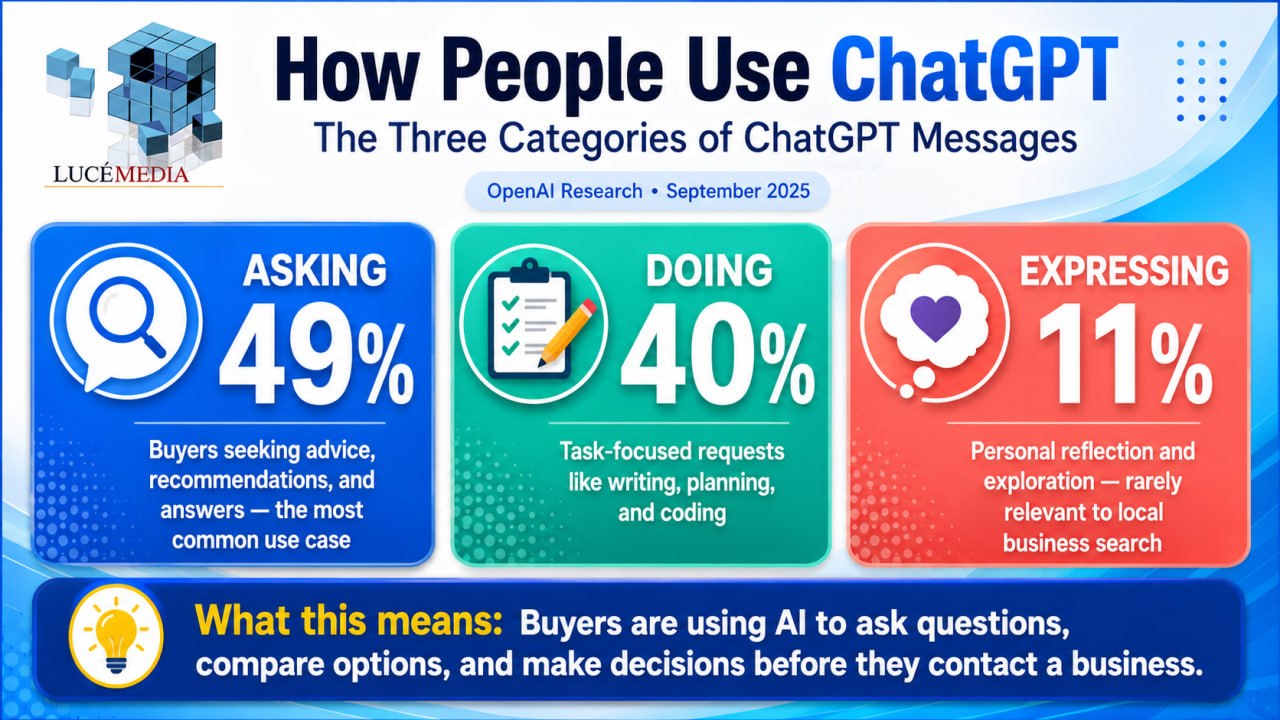
The short answer is this: people stopped talking to computers like computers and started talking to them like people. According to OpenAI's September 2025 research paper, published through the National Bureau of Economic Research and based on analysis of over 1.5 million conversations, 49% of all ChatGPT messages fall into the Asking category, where users seek advice, recommendations, or information. That is the largest single category of ChatGPT use, and it has been growing.
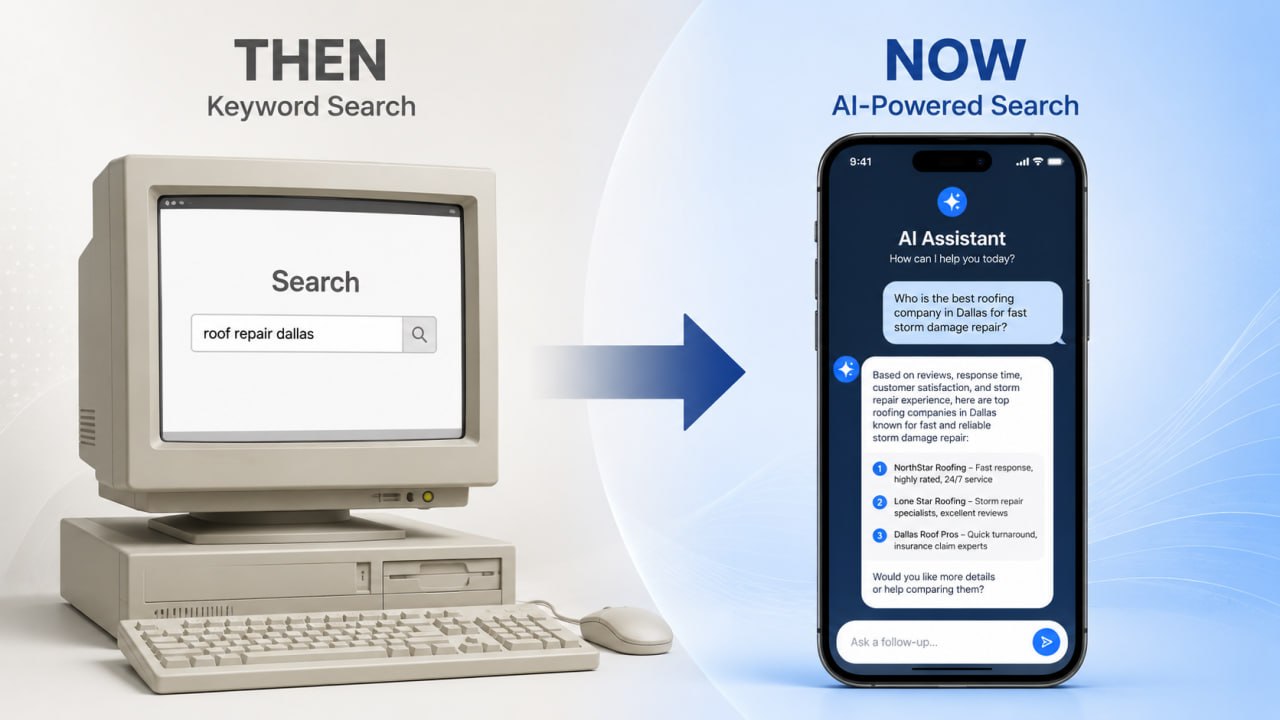
Think about the difference in how you talk to a real person versus how you used to use Google. You would never walk up to a trusted colleague and say "dentist Texas." That would sound strange. You would say something like: "I need to find a dentist in north Austin who is great with nervous adults and takes Blue Cross Blue Shield." That is exactly how people now talk to AI tools. Full sentences. Specific constraints. Personal context.
The Three-Category Breakdown of AI Use
OpenAI's research organized ChatGPT messages into three high-level categories. Understanding these matters because it tells you how your buyers are actually using these tools.
| Category | Share of Messages | What It Means for Your Business |
|---|---|---|
| Asking | 49% | Buyers seeking advice, recommendations, and answers, the most common use case. |
| Doing | 40% | Task-focused requests like writing, planning, and coding. |
| Expressing | 11% | Personal reflection and exploration, which is rarely relevant to local business search. |
The Asking category is where most of your buyers live. They are not asking AI to write something for them. They are asking it for advice. They are asking it who to call, what to buy, and which business in their area can solve their specific problem. The three most common conversation topics across all ChatGPT usage are practical guidance, seeking information, and writing, collectively accounting for about 77% of all conversations, according to the same OpenAI report.
Why Does This Shift Matter for How Your Business Gets Found?
It matters because AI engines do not search the web the way Google does. They pull answers from structured, clear, directly written content. If your website is full of vague benefit language, long sales paragraphs, and no direct answers to real customer questions, AI engines will pass right over you.
Google ranks pages. AI engines cite answers. That distinction changes what good content looks like.
When someone asks Perplexity, "What does a fractional CMO actually do for a manufacturing company?" Perplexity is not looking for the best-designed website. It is looking for the page that most directly and clearly answers that question. AI-cited content is on average fresher and more structured than organically cited content, which is why both the recency of your content and its architecture matter together.
The Real Cost of Being Invisible in AI Answers
Here is what invisibility in AI answers costs you in practical terms. A local HVAC company's ideal customer wakes up on a hot July morning and their air conditioner is not working. They open their phone and ask ChatGPT: "Who is the best HVAC repair company in Frisco that does same-day service?" If that HVAC company has never structured a single page around that question, it will not get mentioned. Its competitor, three blocks away, who has a page that directly answers "Do you offer same-day AC repair in Frisco?" will get cited.
The buyer does not see the first company at all, not because the first company is less qualified, but because its content is not built for the question being asked.
What Does AI-Optimized Content Actually Look Like?
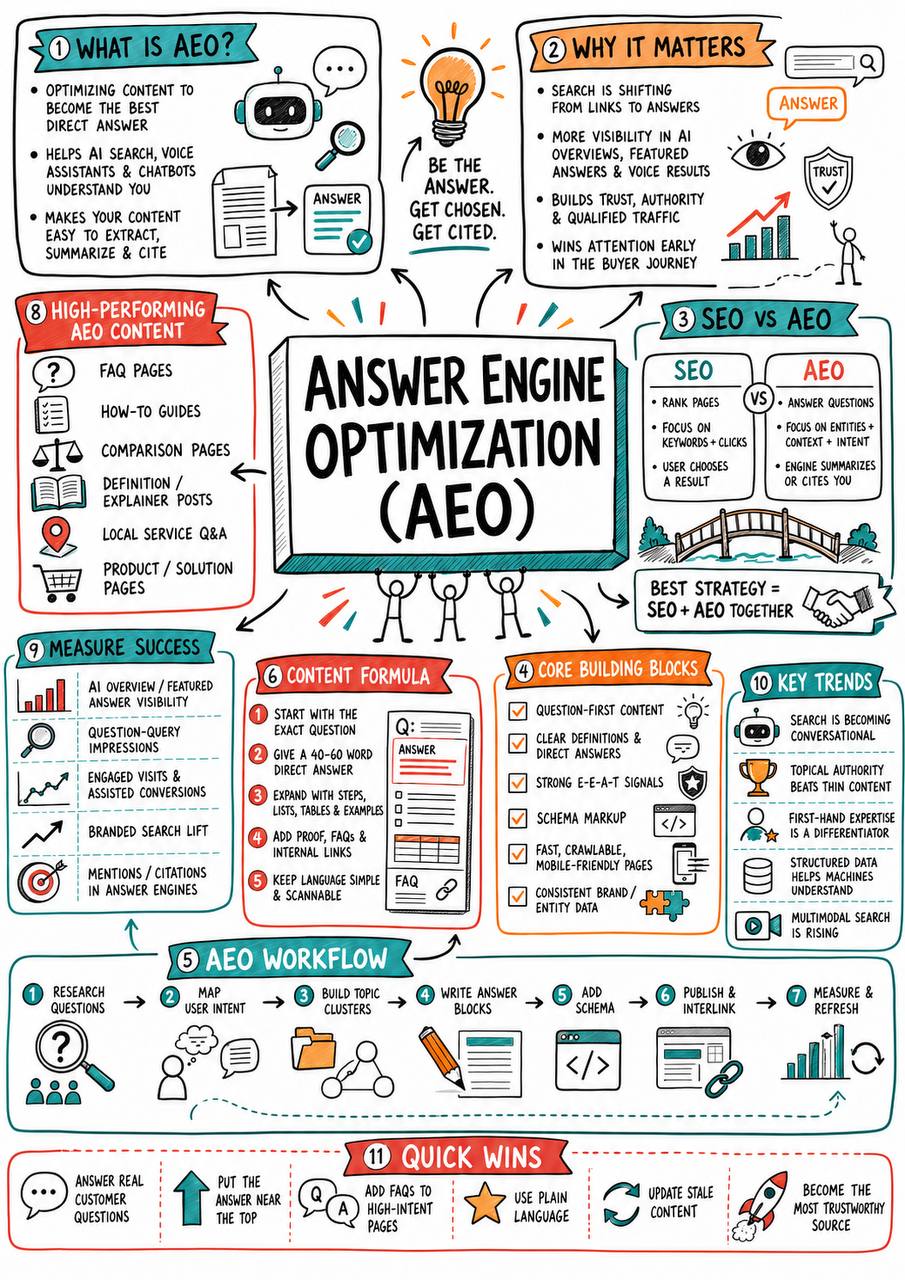
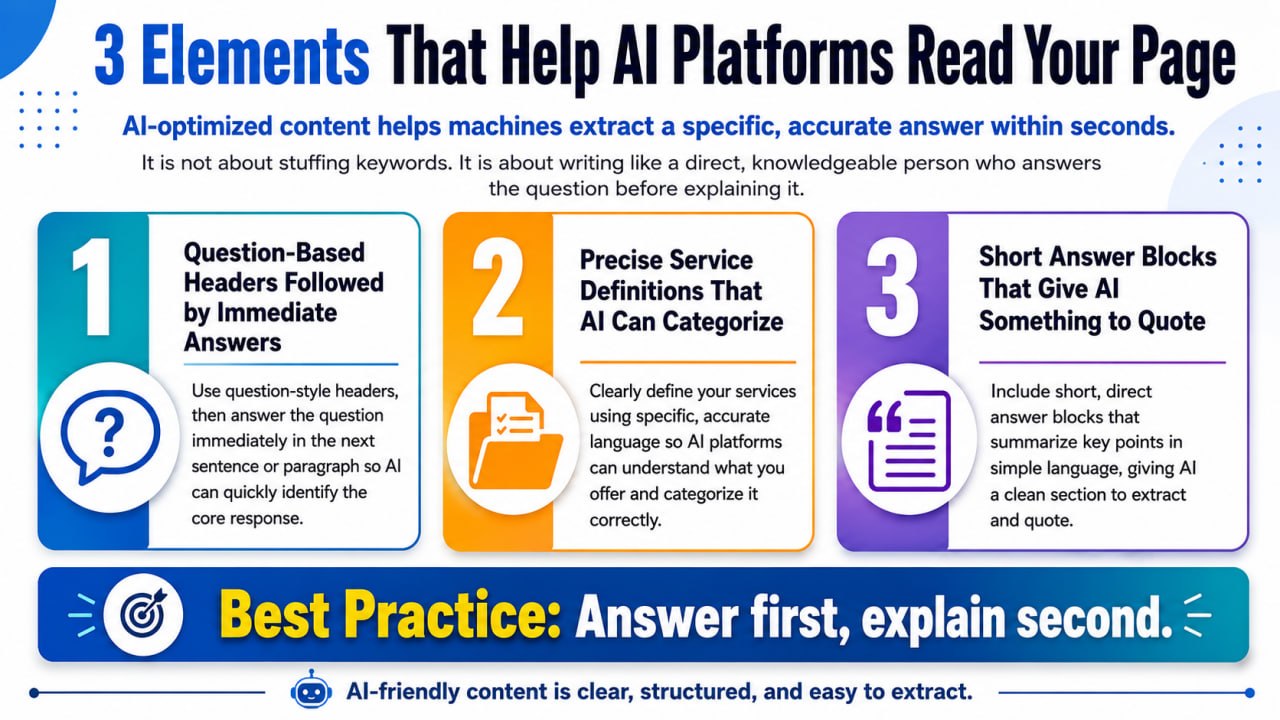
AI-optimized content is structured so that a machine can extract a specific, accurate answer within seconds of reading your page. It is not about stuffing keywords. It is about writing like a direct, knowledgeable person who answers the question before explaining it.
There are three elements that make content extractable by AI engines.
Question-Based Headers Followed by Immediate Answers
Every major section of your web content should open with a question phrased the way a buyer would actually ask it. Then answer the question in the very next sentence or two. Do not make the reader scroll past a paragraph of context before getting the answer.
Wrong way to structure a home services page:
Heading: Our HVAC Services
Body: We have been serving the Dallas-Fort Worth area for over 20 years with a commitment to quality and customer satisfaction...
Right way to structure a home services page:
Heading: Do You Offer Same-Day AC Repair in Frisco?
Answer: Yes. We provide same-day AC repair service throughout Frisco, Prosper, and McKinney, typically arriving within four hours of your call.
Context: Then explain how the service works, what it costs, and what to expect.
The second version gives the AI engine an extractable answer it can quote directly. The first version gives it marketing copy that answers nothing specific.
Precise Service Definitions That AI Can Categorize
AI engines are text-matching tools at their core. They match user questions to content by identifying entities, concepts, and relationships. If your website says you offer excellent care or comprehensive services, the AI has nothing concrete to match against a specific buyer question.
| Version | What It Says | What AI Can Match It To |
|---|---|---|
| Vague | We provide excellent senior home care services with compassion and dedication. | Almost nothing specific. AI cannot match this to a buyer asking for medication reminders for a senior in an assisted living facility. |
| Specific | We provide non-medical home care for seniors, including grocery shopping, light housekeeping, and medication reminders, serving families in assisted living communities throughout Collin County. | AI can match this to dozens of specific buyer questions about location, service type, and care setting. |
The specific version is longer by about 25 words. It is also worth far more in AI visibility because every extra specific detail is a matching point for a buyer's question.
Short Answer Blocks That Give AI Something to Quote
Every major section of your content should contain what we call an answer block: a 40-to-60 word direct answer to the section's headline question. This is what AI engines scan for. It needs to be self-contained, which means someone who read only that block would still have a complete answer to the question.
Example answer block:
Header: What Should I Expect at My First Physical Therapy Appointment for a Knee Injury?
Answer block: Your first appointment includes three steps: a movement assessment to identify range limitations, a pain evaluation to map where and when discomfort occurs, and a personalized exercise plan you take home that day. Appointments typically run 60 minutes. You do not need a referral to book.
That block is specific, direct, and structured. ChatGPT can lift it, credit the clinic, and send a buyer to their site. That is the goal.
How Do You Know If Your Business Shows Up in AI Searches?
Most business owners assume that if they rank well in Google, they are probably fine in AI searches too. That assumption is wrong, and it is costing businesses real referrals every day.
Google ranking and AI citation are two different systems with two different requirements. A business can rank on page one of Google and never appear in a single ChatGPT or Perplexity answer. It can also appear in AI answers for competitive terms without a strong Google ranking.
The fastest way to find out where you stand is to run a free AI visibility check at Run My AI Visibility Check. The tool tests whether your business name appears when local buyers ask AI engines for help in your category and location. It takes about two minutes and gives you a clear picture of your current AI visibility score.
What a Low AI Visibility Score Actually Tells You
A low score does not mean your business is bad. It means your content is not structured for extraction. It means your service pages answer questions no one is asking while ignoring the questions buyers actually type into AI tools every day.
The fix is not a full website rebuild. In most cases, it is a targeted restructuring of your most important pages: your home page, your main service pages, and your FAQ or resources section. That restructuring, done correctly, can move a business from invisible to cited within 60 to 90 days.
What Is the Fastest Way to Improve How You Show Up in AI Searches?
The fastest path to better AI visibility is a focused content restructuring on your highest-traffic pages. You do not need to rewrite your entire website. Start where buyers are most likely to land.
Here is the sequence that produces the fastest results:
- Audit your current AI visibility. Run a free AI visibility check at getcitedai.ai and establish your baseline before you change anything.
- Identify the ten questions your buyers actually ask. These are full-sentence buyer questions, not just shorthand keyword strings.
- Restructure your top three pages around those questions. Rewrite your main service page headers as questions and add a 40-to-60 word answer block immediately below each one.
- Add or update your FAQ section. Write 8 to 12 questions in the exact conversational language your buyers use and answer each one in two to four direct sentences.
- Add a Last Updated date to every restructured page. Freshness signals help AI engines trust that your information is maintained and current.
Frequently Asked Questions
How do customers search with AI differently than with Google?
With Google, people type short keyword phrases like 'plumber near me' or 'best dentist Frisco.' With AI tools like ChatGPT and Perplexity, they type full conversational sentences that describe their specific situation, timeline, and preferences. The AI understands context, so buyers give it more of it. This changes what content your website needs to answer in order to get found.
What percentage of ChatGPT conversations are people asking questions?
According to OpenAI's September 2025 research paper, based on analysis of over 1.5 million conversations, 49% of all ChatGPT messages fall into the 'Asking' category. This means nearly half of all AI interactions are people seeking advice, recommendations, or information rather than asking the AI to complete a task. That is the largest single category of ChatGPT use.
What is the difference between SEO and AEO for local businesses?
SEO (search engine optimization) helps your business rank higher in Google search results. AEO (answer engine optimization) helps your business get cited and recommended by AI tools like ChatGPT, Perplexity, and Gemini. Both matter, but they require different content structures. SEO relies on keyword placement and backlinks. AEO relies on direct answer blocks, question-based headers, and specific service definitions that AI engines can extract and quote.
How long does it take for AI optimization changes to show results?
Most businesses that restructure their content for AI visibility see measurable changes in 60 to 90 days. AI engines like Perplexity and ChatGPT refresh their knowledge on different timescales, but consistent, well-structured content that clearly answers common buyer questions can begin earning citations within weeks of publication. Running a visibility check at getcitedai.ai before and after restructuring gives you a clear before-and-after comparison.
Is AI search optimization right for a small local business?
Yes, and small local businesses may benefit more than large brands. When a buyer asks an AI for 'the best HVAC company in McKinney that does same-day service,' the AI is looking for the most specifically relevant answer, not the biggest company. A local business with highly structured, specific content about its service area and process has a real advantage over a national chain with generic website copy. AI rewards specificity, and local businesses can be more specific than national brands can.
What is the best type of content for AI search visibility?
The content formats AI engines cite most reliably are FAQ sections, numbered step-by-step guides, defined service descriptions with specific locations and scope, and quick answer blocks at the top of major sections. Long promotional paragraphs, vague benefit statements, and generic about-page copy are almost never cited. The pattern is consistent: direct answers to specific questions outperform polished marketing language every time.
How do I know if my business shows up when buyers ask AI for recommendations?
The fastest way is to run a free AI visibility check at getcitedai.ai. The tool tests your business against real buyer questions in your category and location, and it shows you what AI engines are saying about you when buyers ask. It takes about two minutes and gives you a clear baseline score so you know exactly where you stand before making any content changes.
Does AI search affect all industries or just certain types of businesses?
AI search affects any business category where buyers ask questions before making a decision -- which covers almost every industry. Healthcare, home services, legal, financial services, real estate, dental, restaurants, and local retail are all high-impact categories. If your buyers have questions before they buy, those questions are now going to AI tools first. The businesses that answer those questions on their websites will be cited. The ones that do not will be passed over.
Final Thoughts
How customers search with AI has already changed. Nearly half of all ChatGPT messages are people asking questions, seeking advice, and looking for recommendations. If your business is not structured to answer those questions directly, you are not in the conversation.
Three things you can do right now:
- Run a free AI visibility audit at getcitedai.ai so you know your baseline.
- Pick your top three service pages and rewrite the headers as questions, then add a direct 40-to-60 word answer block immediately below each header.
- Write or update your FAQ section with questions phrased the way your buyers actually talk, and answer each one directly in two to four sentences with no hedge language.
The shift from keyword search to AI-driven questions is not slowing down. It is accelerating. The businesses that structure their content for this reality now will hold the advantage for years. The ones that wait will be playing catch-up.
Run My AI Visibility Check and see exactly where you stand.
About the Author
Mark Toney is the founder and CEO of Luce Media. He specializes in fractional CMO strategy and AI search visibility and has more than 11 years of experience helping B2B companies and local businesses build marketing systems that generate measurable revenue. He is the creator of the Executive Marketing Readiness Review and has documented $4.21M in attributable revenue results for clients, including Goelzer Industries.