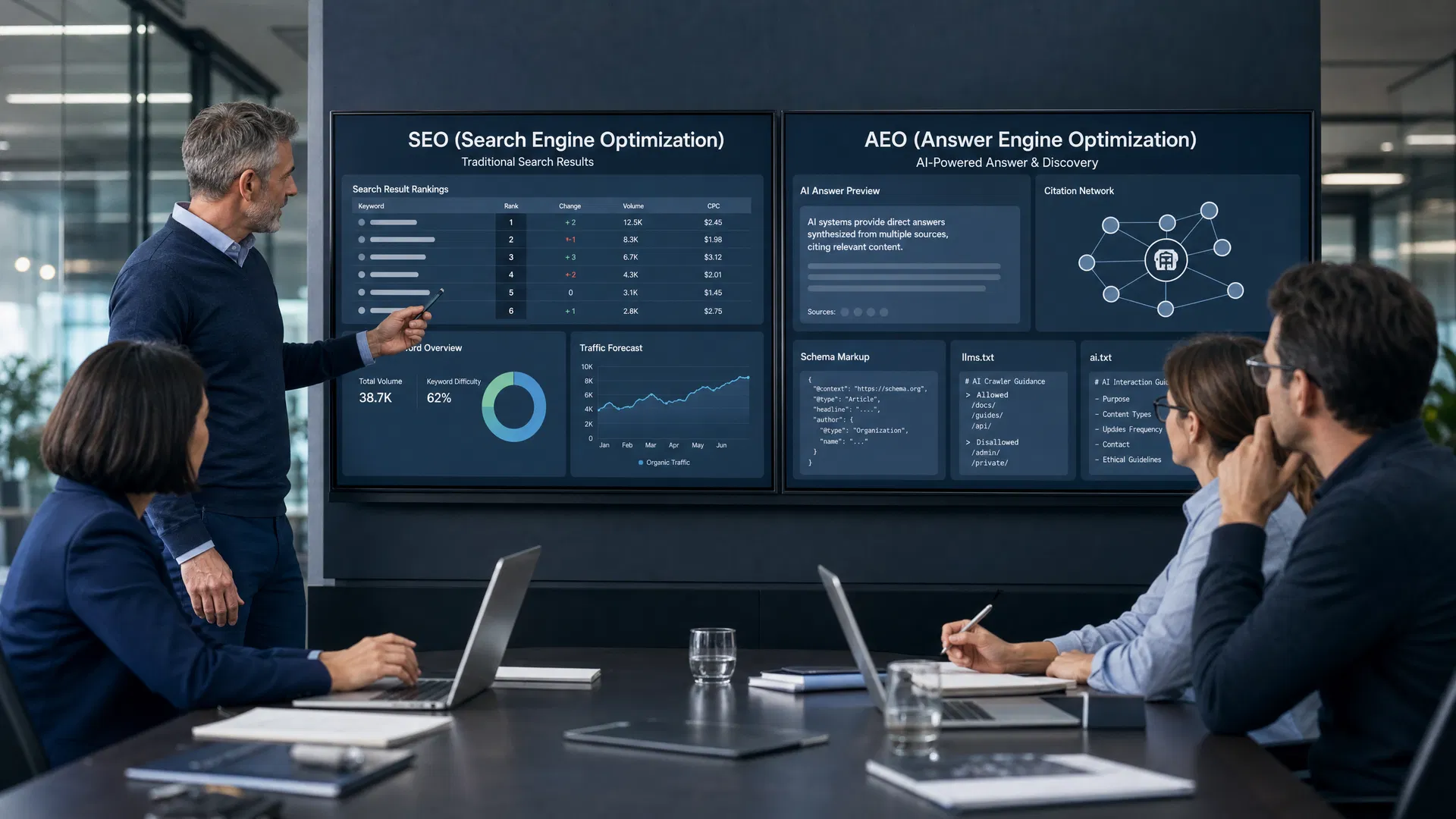
If you are asking whether AEO and SEO are the same thing, the short answer is no. SEO still matters. AEO matters too. The issue is that buyers now discover businesses in both traditional search results and AI-generated answers, which means visibility has to work across both environments.
AEO stands for Answer Engine Optimization. It is the extra layer of technical and content work that helps AI systems understand what your business does, trust the signals they see, and cite or recommend you when someone asks a relevant question in ChatGPT, Gemini, Perplexity, or AI Overviews.
The fast answer
SEO helps your pages rank and earn traffic. AEO helps your business get understood, cited, and recommended inside AI answers. The smartest move is not choosing one over the other. It is making sure both layers are working together.
What is SEO?
SEO is the process of improving your website so search engines can crawl, understand, rank, and send traffic to your pages. It focuses on visibility in traditional search results through technical health, relevance, authority, internal linking, and pages built around real search demand.
What is AEO?
AEO, or Answer Engine Optimization, is the process of making your business easier for AI systems to understand, trust, and cite when users ask questions. It focuses on answer surfaces such as ChatGPT, Gemini, Perplexity, and AI Overviews, where buyers often get recommendations before clicking a link.
What is the difference between SEO and AEO?
The difference between SEO and AEO is that SEO is designed to win rankings and traffic, while AEO is designed to win inclusion inside AI-generated answers, summaries, and recommendations. They overlap, but AEO requires more emphasis on structured meaning, answer formatting, entity clarity, and machine-readable trust signals.
Primary goal
SEO
Rank pages and earn qualified clicks from traditional search results.
AEO
Earn inclusion inside AI answers, summaries, citations, and vendor recommendations.
Primary surface
SEO
Google and Bing organic listings, map results, and classic search experiences.
AEO
ChatGPT, Gemini, Perplexity, AI Overviews, and assistant-style discovery layers.
Content preference
SEO
Keyword-aligned pages, internal linking, depth, relevance, and topical coverage.
AEO
Direct answers, FAQs, entities, structured facts, and machine-readable context.
Technical emphasis
SEO
Crawlability, indexation, metadata, canonical control, speed, and site health.
AEO
Schema markup, llms.txt, ai.txt, entity clarity, citation readiness, and extractable structure.
Main success signal
SEO
Higher rankings, impressions, clicks, and organic traffic growth.
AEO
More AI mentions, citations, recommendations, and answer-surface visibility.
Risk if used alone
SEO
You may rank reasonably well and still be absent when AI tools recommend vendors.
AEO
You may improve answer clarity, but without SEO foundations your authority remains weaker.
| Comparison point | SEO | AEO |
|---|---|---|
| Primary goal | Rank pages and earn qualified clicks from traditional search results. | Earn inclusion inside AI answers, summaries, citations, and vendor recommendations. |
| Primary surface | Google and Bing organic listings, map results, and classic search experiences. | ChatGPT, Gemini, Perplexity, AI Overviews, and assistant-style discovery layers. |
| Content preference | Keyword-aligned pages, internal linking, depth, relevance, and topical coverage. | Direct answers, FAQs, entities, structured facts, and machine-readable context. |
| Technical emphasis | Crawlability, indexation, metadata, canonical control, speed, and site health. | Schema markup, llms.txt, ai.txt, entity clarity, citation readiness, and extractable structure. |
| Main success signal | Higher rankings, impressions, clicks, and organic traffic growth. | More AI mentions, citations, recommendations, and answer-surface visibility. |
| Risk if used alone | You may rank reasonably well and still be absent when AI tools recommend vendors. | You may improve answer clarity, but without SEO foundations your authority remains weaker. |
Is AEO replacing SEO?
No. AEO is not replacing SEO. Strong SEO still gives you crawlable pages, authority, relevance, and discoverable content. But AI systems use those foundations differently, so businesses now need an additional layer of work that helps answer engines interpret, connect, and confidently surface the right information.
Why is good SEO no longer enough for AI search?
Good SEO is no longer enough because many discovery journeys now start and end inside AI-assisted search experiences. A company can rank decently and still be absent from AI recommendations if its site lacks structured data, answer-ready sections, consistent entities, and clear signals about what should be cited.
If you want a practical example of how AI is compressing discovery before the click, read our breakdown of Google’s zero-click shift. The market context matters because the old assumption that rankings alone guarantee consideration is becoming less reliable.
I already have an SEO agency. Why do I still need AEO?
You may still need AEO even if you already have an SEO agency because many SEO retainers are built around rankings, traffic, content calendars, backlinks, and technical fixes, not around llms.txt, ai.txt, citation readiness, entity disambiguation, or answer extraction. The disciplines are connected, but the implementation is not always included.
What does AEO actually include?
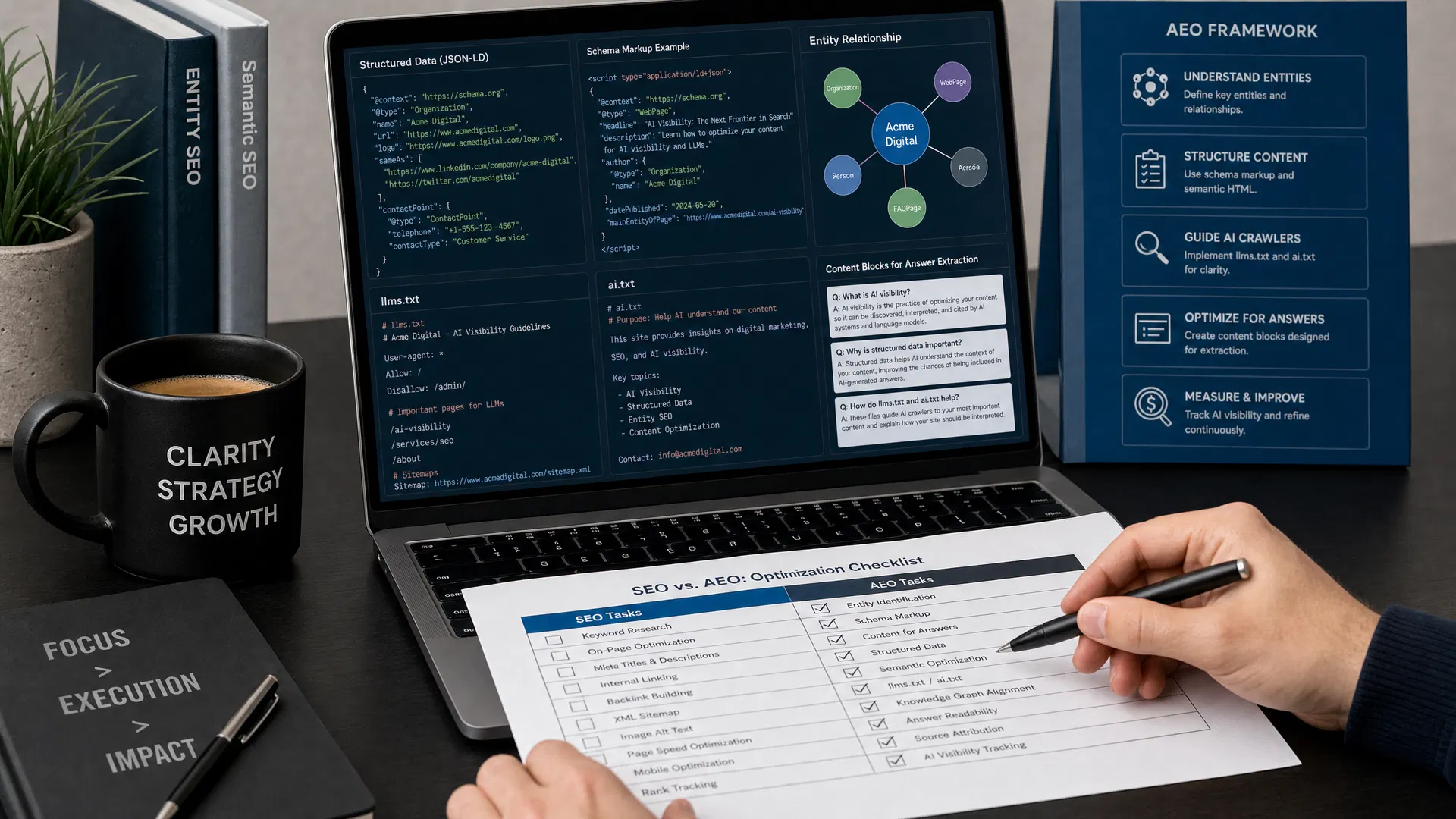
AEO includes the technical and content work that helps AI tools read your business correctly and quote it accurately. That usually means structured data, schema markup, llms.txt, ai.txt, stronger service definitions, entity cleanup, extractable question-and-answer blocks, and trust signals that reduce ambiguity across your key pages.
Structured data and schema markup
What it does
Turns important business facts into machine-readable context that AI systems can interpret more confidently.
Why it matters
It reduces ambiguity around your services, organization, expertise, and page purpose.
llms.txt and ai.txt guidance
What it does
Clarifies which content, resources, and guidance matter most to AI crawlers and answer systems.
Why it matters
It gives models cleaner signals about what should be read, interpreted, and referenced.
Entity clarity across key pages
What it does
Aligns your brand, services, audiences, locations, and proof points so your business is easier to classify.
Why it matters
AI tools struggle when a company sounds vague, fragmented, or inconsistent across core pages.
Answer-shaped content blocks
What it does
Adds concise definitions, FAQs, and self-contained sections that directly answer buyer questions.
Why it matters
Answer engines prefer content they can quote, summarize, and attribute quickly.
Citation and trust cleanup
What it does
Makes supporting signals across the web and on your site more consistent, verifiable, and easier to trust.
Why it matters
Confidence goes up when AI systems see the same facts repeated clearly in multiple places.
| AEO workstream | What it does | Why it matters |
|---|---|---|
| Structured data and schema markup | Turns important business facts into machine-readable context that AI systems can interpret more confidently. | It reduces ambiguity around your services, organization, expertise, and page purpose. |
| llms.txt and ai.txt guidance | Clarifies which content, resources, and guidance matter most to AI crawlers and answer systems. | It gives models cleaner signals about what should be read, interpreted, and referenced. |
| Entity clarity across key pages | Aligns your brand, services, audiences, locations, and proof points so your business is easier to classify. | AI tools struggle when a company sounds vague, fragmented, or inconsistent across core pages. |
| Answer-shaped content blocks | Adds concise definitions, FAQs, and self-contained sections that directly answer buyer questions. | Answer engines prefer content they can quote, summarize, and attribute quickly. |
| Citation and trust cleanup | Makes supporting signals across the web and on your site more consistent, verifiable, and easier to trust. | Confidence goes up when AI systems see the same facts repeated clearly in multiple places. |
Do I need both SEO and AEO?
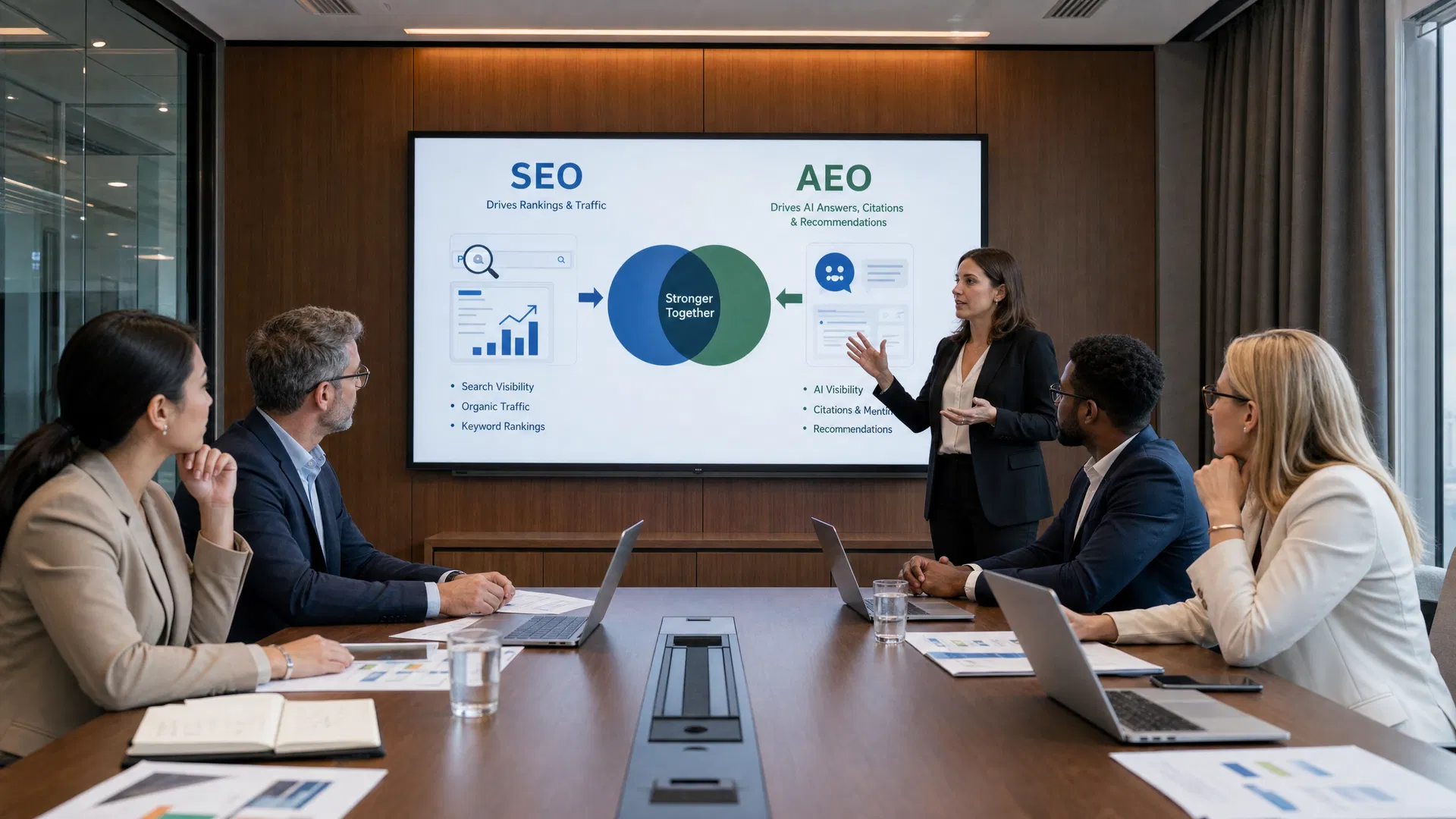
Yes. SEO and AEO work best together. SEO gives your site the authority and discoverability to compete, while AEO makes that authority easier for AI systems to interpret and cite. If you only do SEO, you risk ranking without being recommended. If you only do AEO, you weaken the foundation.
How does Get Cited AI handle the AEO side?
Get Cited AI handles the AEO side by identifying where your business is being missed, then closing the technical and content gaps that prevent AI systems from citing you confidently. The Done For You service at $497 installs the core visibility layer quickly so your SEO work has a better chance of carrying into AI search.
What should you do next if AI tools are not surfacing your business?
If AI tools are not surfacing your business, do not assume the problem will fix itself with more blog posts or more backlinks. Start with a visibility baseline, identify the missing signals, and address them directly. That is the fastest way to stop guessing and start improving how AI systems interpret your company.
If you want a next step, start with the Get Cited AI Resources page, read our composite AI visibility case study, and then run the audit.
Frequently Asked Questions About AEO vs SEO
Is AEO replacing SEO?
No. AEO is not replacing SEO. Strong SEO still gives your business crawlable pages, authority, relevance, and discoverable content. AEO adds the extra work that helps AI systems interpret, cite, and recommend that content inside answer-first search experiences.
Do I need both SEO and AEO?
Yes. SEO and AEO are complementary. SEO helps your pages get found and trusted in traditional search, while AEO helps AI tools understand which parts of your site deserve to be quoted, summarized, or recommended when users ask direct questions.
Can my SEO agency handle AEO too?
Some agencies can, but many do not include it by default. If your current SEO partner is not addressing structured data depth, llms.txt, ai.txt, entity cleanup, answer-ready content blocks, and AI citation visibility, then the AEO layer is probably still missing.
What does AEO actually include?
AEO usually includes schema markup, structured data, llms.txt, ai.txt, stronger entity clarity, visible FAQ and Q-and-A sections, citation alignment, and clearer service or expertise pages. The goal is to make your business easier for AI systems to interpret and reference accurately.
How fast can AEO changes start helping AI visibility?
That depends on the site, the market, and how many clarity issues exist, but technical cleanup and content-structure improvements can begin changing how AI systems interpret a business relatively quickly. The important step is measuring the gap first instead of guessing.
Is Get Cited AI only for companies that do not have SEO?
No. Get Cited AI is often most useful for companies that already have some SEO foundation but are not being cited or recommended well in AI search. It closes the answer-engine gap that many businesses discover after traffic work is already underway.