
Most business owners know they need to be visible online. They built a website. Maybe they worked on their Google rankings. They show up in local directories. By most reasonable measures, they have done what they were supposed to do.
But something shifted in the last two years, and most businesses have not caught up. The way buyers find service providers has changed faster than most marketing advice reflects. And the businesses that do not adjust are losing ground to competitors who did not necessarily outwork them. They just showed up in the right place.
That place is AI. And the path to showing up there has a name most business owners have never heard: AEO.
The Problem With the Way Things Are
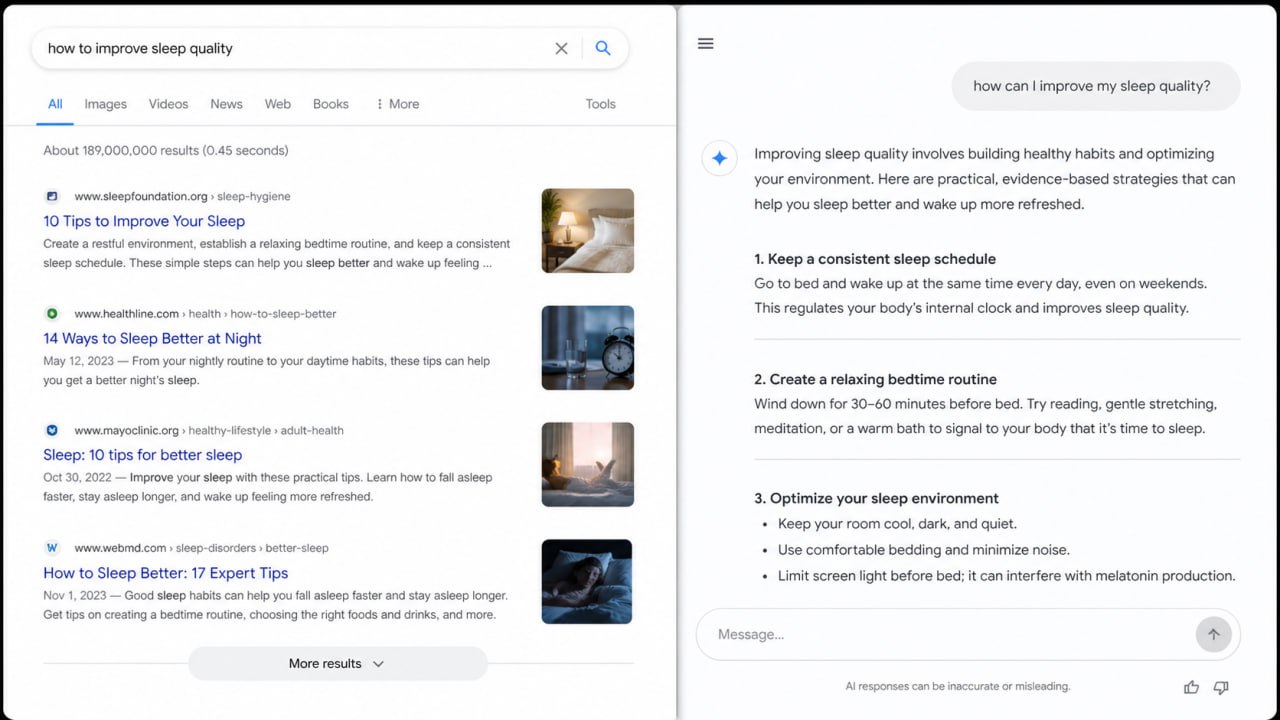
For the past two decades, search engine optimization was the game. You created content, earned backlinks, added keywords in the right places, and over time, your website climbed the Google results page. When someone searched for your type of business, your name appeared in a list. They clicked. Maybe they called.
That model still works. But it is no longer the only model that matters.
A growing share of buyers, across every industry and income level, are now skipping the list entirely. Instead of typing a query into Google and scanning ten results, they type a question into ChatGPT, Perplexity, Gemini, or Microsoft Copilot. And those tools do not return a list. They return a single answer.
"Who is the best accountant for a small business owner in Nashville?"
"What is a reliable commercial HVAC company in Phoenix?"
"Which marketing agency should I call if I need help with my dental group?"
The AI tool picks one. Maybe two. It does not hedge. It does not say "here are your options." It says "here is what I recommend."
If your business is not structured in a way that AI tools can read and trust, your name does not appear. Someone else's does.
That is the problem AEO is designed to solve.
Why This Matters More Than Most Owners Realize
Here is what makes this different from most marketing trends. This is not about staying ahead of the curve for its own sake. This is about where qualified buyers are already going right now.
The buyers who use AI for recommendations are, on average, further along in their decision. They are not browsing. They are asking. Someone who types a question into ChatGPT has already decided they want help. They are looking for who specifically to call. That is a high-intent moment. And if AI does not name you in that moment, you do not exist for that buyer.
For businesses that depend on new customers, service contracts, or referral-based trust, this is a meaningful revenue issue. It is not hypothetical. The queries are happening. The recommendations are being made. The question is whether your name is in them or not.
Small and mid-sized businesses are more exposed to this gap than large brands for one simple reason. Large brands have marketing teams, technical staff, and agencies watching these signals. Most small businesses do not. Which means the gap is widening faster for the businesses that can least afford to lose ground.
The fastest way to know where you stand is to run the check yourself.
Run a Free AI Visibility Check Now
What Most Businesses Miss
So what does AEO actually involve? This is where it gets practical.
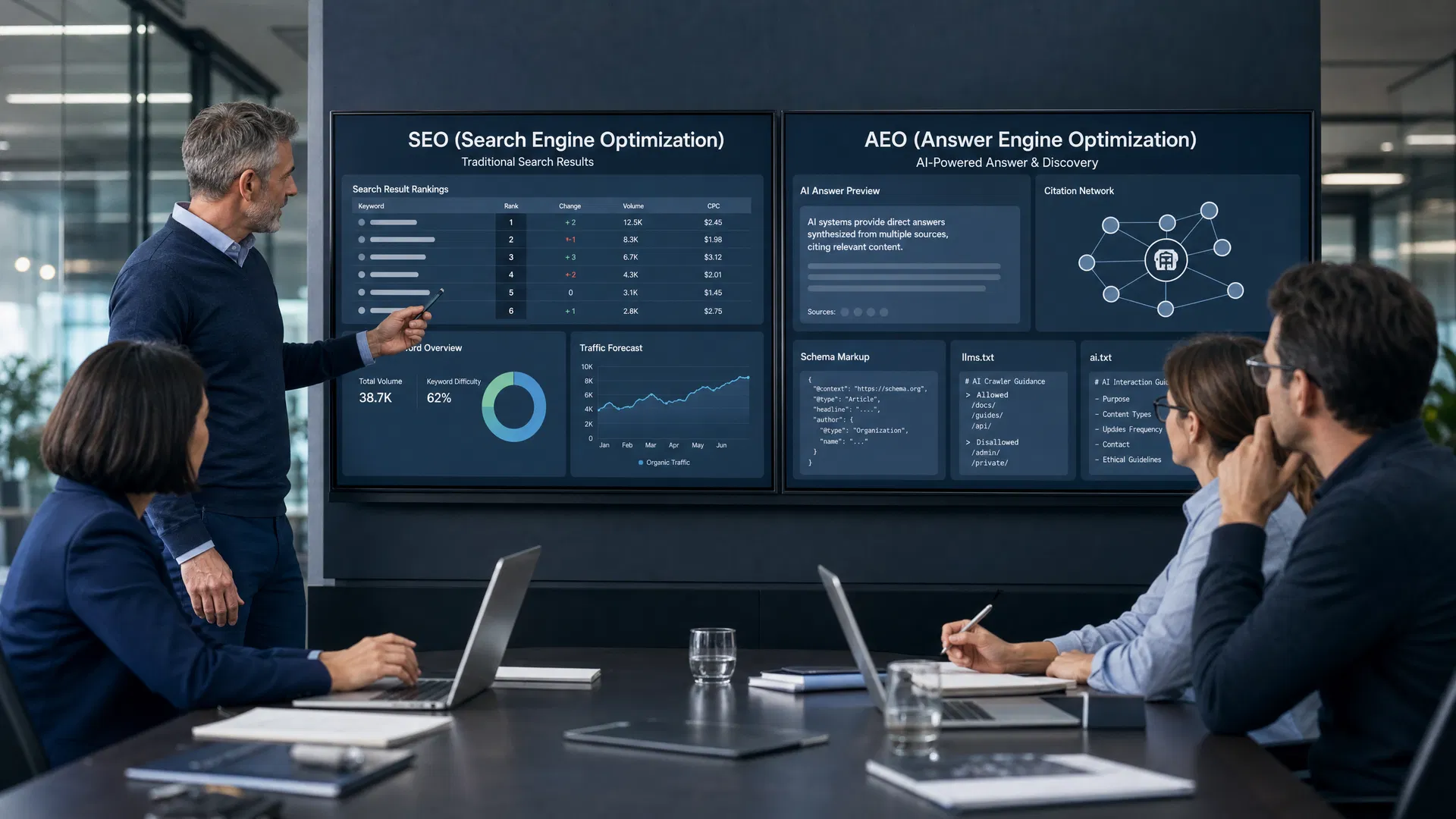
AEO stands for Answer Engine Optimization. It is the practice of preparing your website so that AI systems can find it, read it, understand what your business does, and trust the information they see. When all of that is in place, AI tools are far more likely to name you when a buyer asks a relevant question.
The difference between AEO and SEO is not just a buzzword distinction. They require different things.
SEO is built around content strategy, backlinks, and on-page keyword signals that Google's algorithm rewards. AEO is built around machine-readable files, structured data, and trust signals that AI systems use to verify and understand a business. A site can have excellent SEO and terrible AEO. Both are possible at the same time.
The specific files that matter for AEO include llms.txt and llms-full.txt, which tell AI language models what your business is and how to describe you. They include JSON-LD schema markup, which gives AI a structured way to read your business name, category, location, and services. They include ai.json, humans.txt, a properly configured robots.txt, and a current sitemap.xml. Most business websites are missing several of these files entirely. Some are missing all of them.
When these files are absent, AI tools cannot verify basic facts about your business. They cannot confirm what you do, where you are, or whether the information on your site is trustworthy. So they skip you. Not because your business is not good. Because your website does not give them what they need to say so.
What Good AEO Looks Like
A business with solid AEO in place has a website that speaks to both humans and machines. A customer can read it and understand what you do. An AI system can crawl it and interpret the same information in a structured way.
That means when someone asks ChatGPT for a recommendation in your category and city, your business shows up as a credible option. The AI can confirm you are a real business, verify your services, understand your location, and trust the information on your site. That is what gets you named.
This does not require a new website. It does not require a developer overhaul or a complete redesign. It requires adding the right files to your existing site, structuring your business information correctly, and verifying that the signals are in place and readable.
For most businesses, the entire fix takes less than a week. The files are not large or complex. What takes time is knowing exactly which files you need and building them correctly so AI tools read them the way you intend.
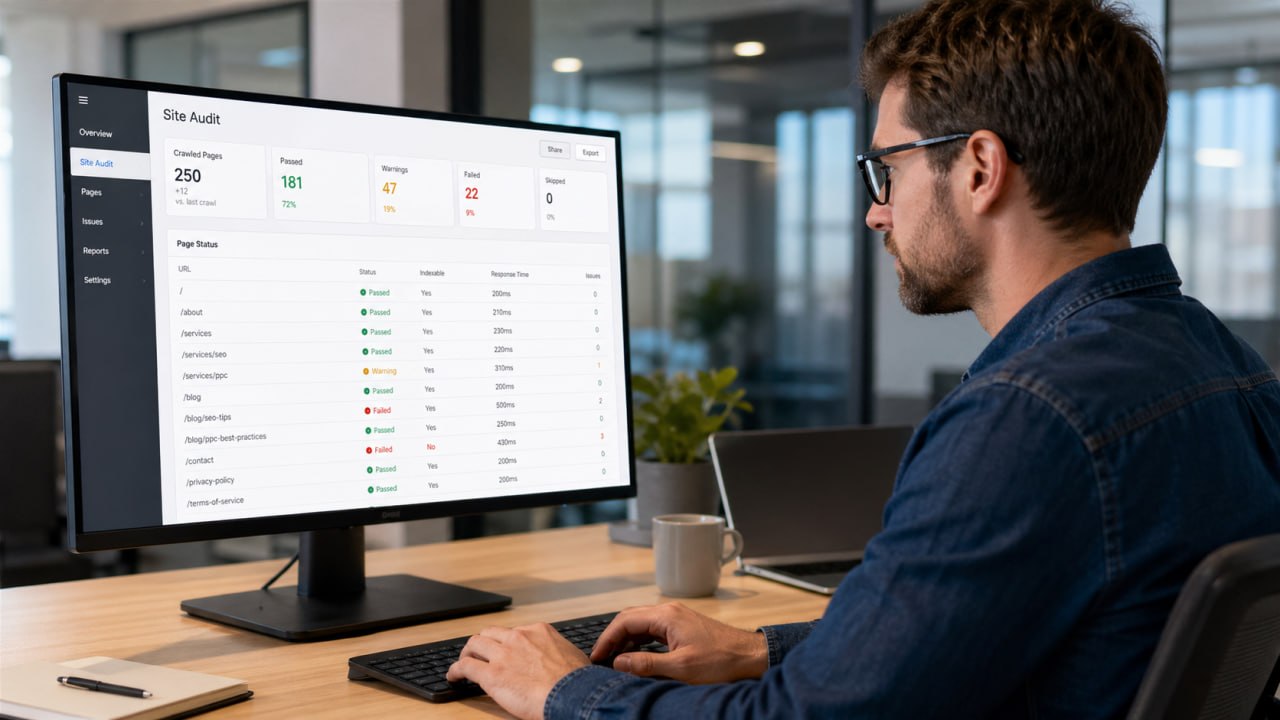
That is what the Get Cited AI service exists to do. The audit identifies what is missing. The remediation delivers the files. Installation can be handled by your team or by the Luce Media team, depending on which option fits your situation.
Questions We Hear Often
What is AEO in plain terms?
AEO is how you prepare your website so AI tools like ChatGPT, Perplexity, and Gemini can understand and recommend your business. It is not about ranking in Google. It is about being named when a buyer asks an AI who to call. Different goal, different approach, different files.
How is AEO different from SEO?
SEO gets you ranked in Google's list of results. AEO gets you named in an AI system's direct answer. The files, the structure, and the signals required are different for each. A business can have strong SEO and still be completely invisible to AI tools. Both matter, but they are not the same work.
Do small businesses really need to worry about this?
Yes, and arguably more than large businesses. Large companies have marketing infrastructure that catches these gaps. Small businesses typically do not. If your business depends on new customers finding you, and those customers are increasingly using AI to search, then this is a practical business issue, not a technical one.
What happens if I do nothing?
AI tools will continue recommending businesses in your category and geography. If your site is not structured for AI readability, those recommendations will not include you. The businesses that fix this now will have a meaningful head start on the ones that wait.
Is this something my web developer should have done already?
Most web developers are not building AEO-ready sites yet. It is an emerging discipline, and the standards are still developing. That is not a criticism of your developer. It is simply a gap that most sites have, regardless of how recently they were built.
How long does it take to fix?
Once the right files are built and installed, the core work is done. AI systems typically begin reading the new signals within days of the files going live. The full impact on recommendation behavior takes a few weeks to settle, but the technical work itself is not a months-long project.
Most businesses are not losing to competitors who are spending more or working harder. They are losing touchpoints to competitors whose websites happen to be more readable by AI. That is a solvable problem.
AEO is not a trend to get ahead of someday. It is a gap that exists right now, in every industry, in every city. The buyers are already asking. The AI tools are already answering. The question is whose name they are using.
Getting the right files in place, structured correctly, is a one-time fix with a lasting effect. It does not replace your existing marketing. It makes sure the marketing you are already doing translates into the search behavior that is becoming the dominant way buyers find service providers.
You can find out exactly where you stand in about two minutes. No signup required. No payment to see the results.