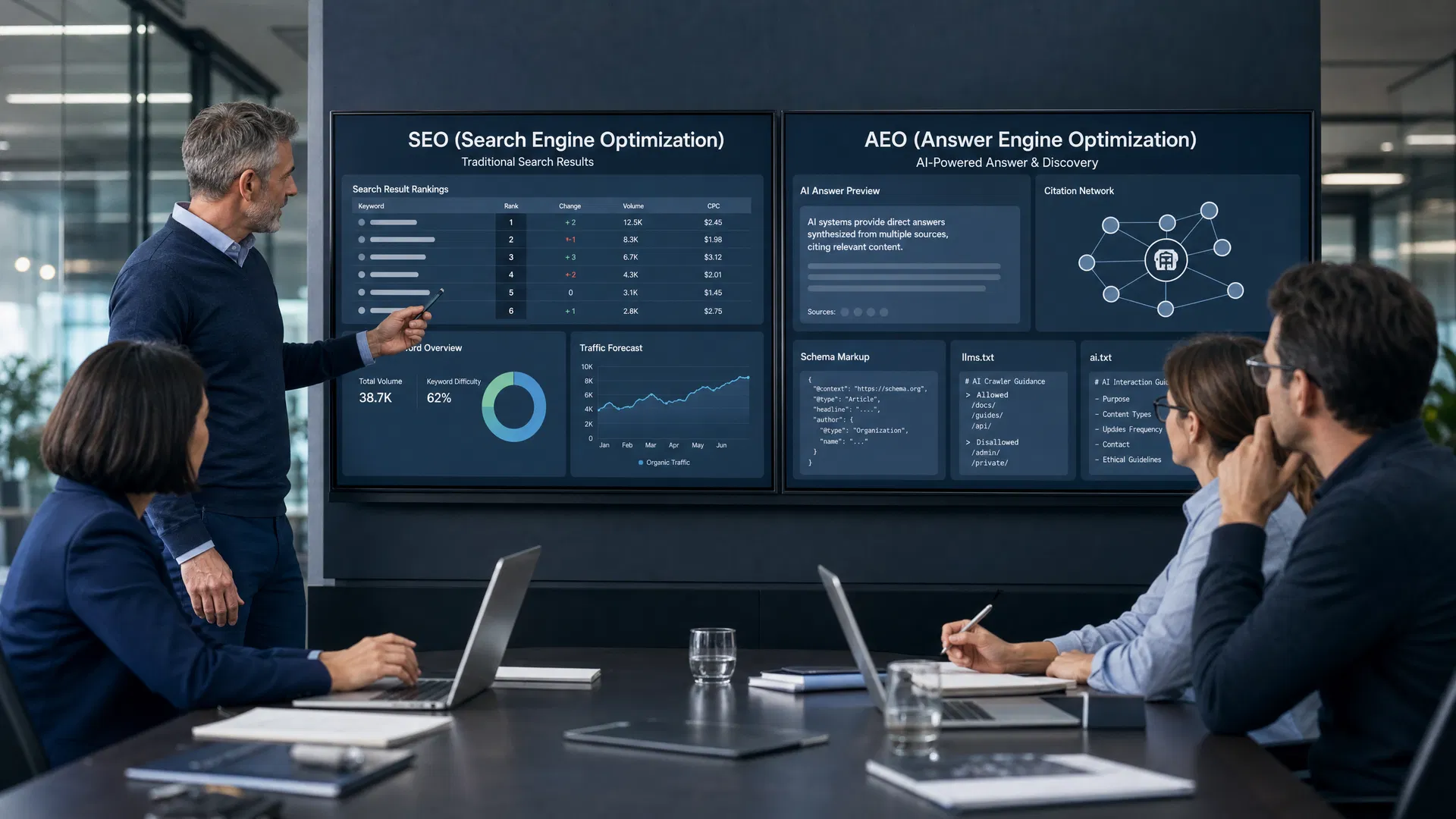

Answer Engine Optimization helps businesses get mentioned inside AI search answers from tools like ChatGPT, Perplexity, and Google AI Overviews. While SEO focuses on ranking pages, AEO focuses on being cited as a trusted source when AI tools answer customer questions.
By Mark Toney, CEO of Get Cited AI and Founder of Luce Media — Last updated: April 28, 2026
Your next customer may never look at a page of blue links. They may open ChatGPT, Perplexity, or Google AI and ask a direct question about the service they need. If your business is not mentioned in that answer, you can lose the opportunity before a website visit ever happens.
This is why Answer Engine Optimization matters for small businesses right now. It is not just about visibility in search results anymore. It is about becoming the business AI tools understand well enough to mention when a buyer asks who to trust.
Answer Engine Optimization at a Glance
Here is what just happened to search. And why you need to know about it.
What it is: Answer Engine Optimization is the practice of making your business easy for AI tools to understand, trust, and recommend to customers.
Why it matters: AI tools like ChatGPT, Perplexity, and Google AI now answer customer questions before they visit your website. If you are not mentioned in those answers, customers may never know you exist.
Who it is for: Any small business owner whose customers ask questions online before deciding who to hire or buy from.
Quick Summary
Answer Engine Optimization for small businesses means making your business easy for AI search tools to find, understand, and recommend. Old-style search was about appearing on page one of Google. The new game is being cited inside answers from tools like ChatGPT, Perplexity, Gemini, and Google AI Overviews.
The Big Ideas
- Old search rules still matter, but they now need to support AI understanding as well as rankings.
- AI tools quote certain businesses and sources. Your goal is to become one of the names they mention.
- Fewer clicks can still mean better leads when the visitor already understands your value before arriving.
- AI systems need clear information about who you are, what you do, where you serve, and why you are credible.
- Small businesses can move faster than bigger competitors that are still ignoring AI visibility.
Why Answer Engine Optimization Matters Right Now
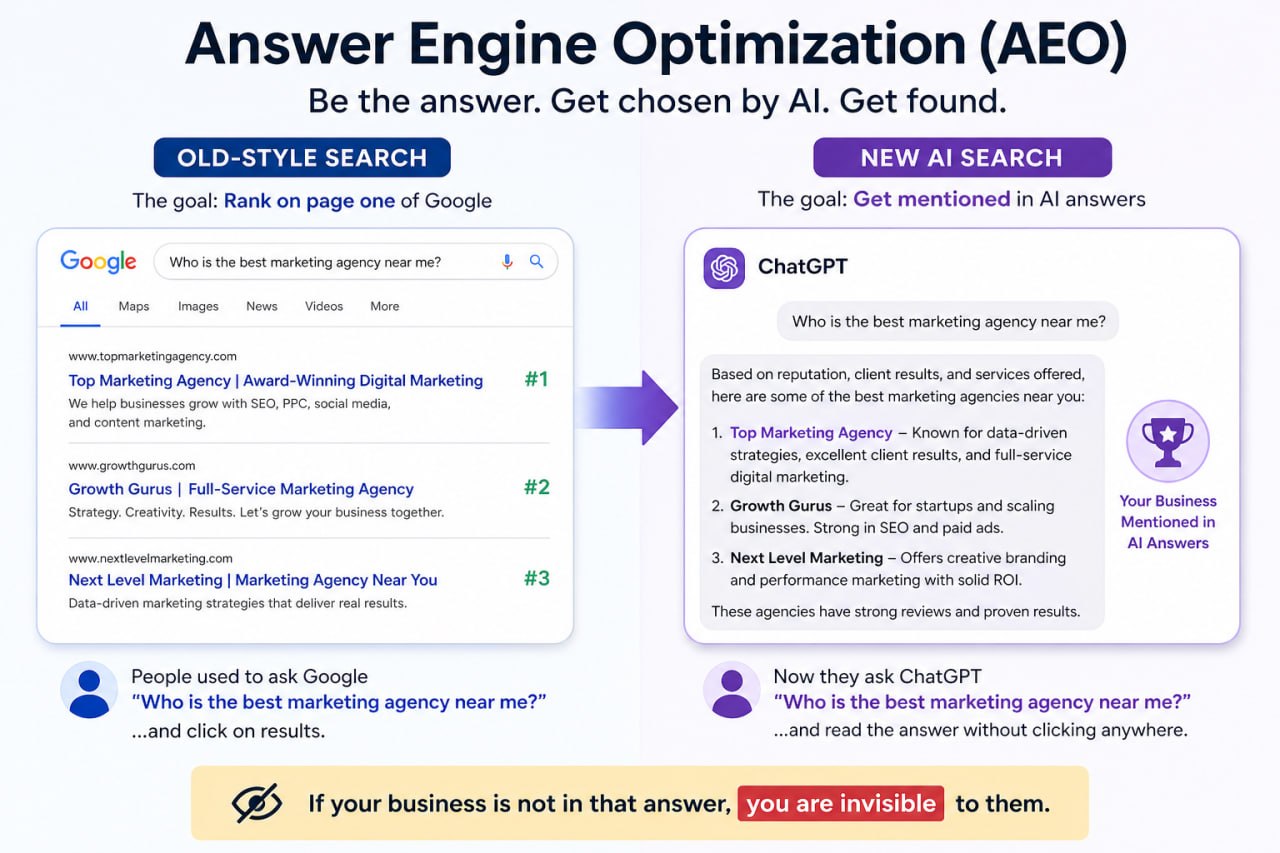
For years, the main question was simple: how do we get to the top of Google? That question still matters. It just is not the whole story anymore.
Customers are now asking AI tools questions such as, “Who is the best payroll provider for a growing company?” or “Which junk removal service should I hire in Memphis?” Those tools do not return a list of websites first. They return a written answer that may mention only a few companies.
If your company is not mentioned, the customer may never know you exist. This is why AEO belongs at the top of your priority list. Without it, invisible brand influence shapes customer decisions you never see.
What Is Answer Engine Optimization
Answer Engine Optimization, or AEO, is about making your business easy for AI tools to understand and mention. Traditional SEO asks whether Google can find and rank your page. AEO asks whether an AI tool can understand your business and recommend it to someone looking for help.
A good AEO page answers the question right away. It uses real customer questions as headings, proves what it claims, and makes your business identity easy to verify. That is the shift: from writing just for clicks to writing for both clicks and citations.
Answer Engine Optimization vs SEO: Why Both Matter
SEO was designed for a page full of links. AEO is built for a page full of answers. Your competitor can rank below you in traditional search and still win the AI citation that shapes the buyer’s decision.
Imagine you rank number two for an important service page while a competitor ranks number five. Then Google shows an AI summary above both links and recommends two companies. Your competitor is named. You are not. A potential customer reads the answer and clicks on your competitor. Your ranking did not save you because the citation mattered more than the list position.
A common mistake is treating SEO and AEO as competing strategies. They are not. SEO creates the foundation. A fast, structured, mobile-friendly website with useful content helps both traditional search ranking and AI visibility. But SEO alone misses the part AI needs most: clear answers, proof, and trust signals.
The AEO Effect: How Answer Engine Optimization Changes Search Behavior
Marketers call this shift the Great Decoupling. More searches happen, but fewer visits reach websites. Google Search Central documentation explains that traditional SEO fundamentals still support AI features in Search, while new interfaces increasingly answer the question before the click [1]. Pew Research Center found in July 2025 that users clicked traditional search links less often when an AI summary appeared [2].
Imagine you publish a detailed guide on choosing accounting software for a construction company. ChatGPT or Google AI may read your guide, summarize it, and help a user decide before they visit your site. If your business is mentioned, that can still be valuable. If your content helps create the answer but your business is never named, the value leaks away to someone else.
This can feel unfair, but it also clarifies the real job. Your goal is no longer just to create content that attracts clicks. It is being the source AI tools recommend when a high-intent customer asks who to trust.
Good News: Better Quality Visitors
Not all traffic is equal. A visitor who arrives after reading an AI answer about your business may be more qualified than a visitor who clicked from a generic search result. That person may already understand the problem, the category, and the reason your business fits.
So yes, some companies may see fewer visits. But those visits can be more valuable because the buyer is farther along. The better question is not whether clicks are down. It is whether high-intent customers asking AI for help are hearing your name.
Three Types of Search: SEO, AEO, and GEO
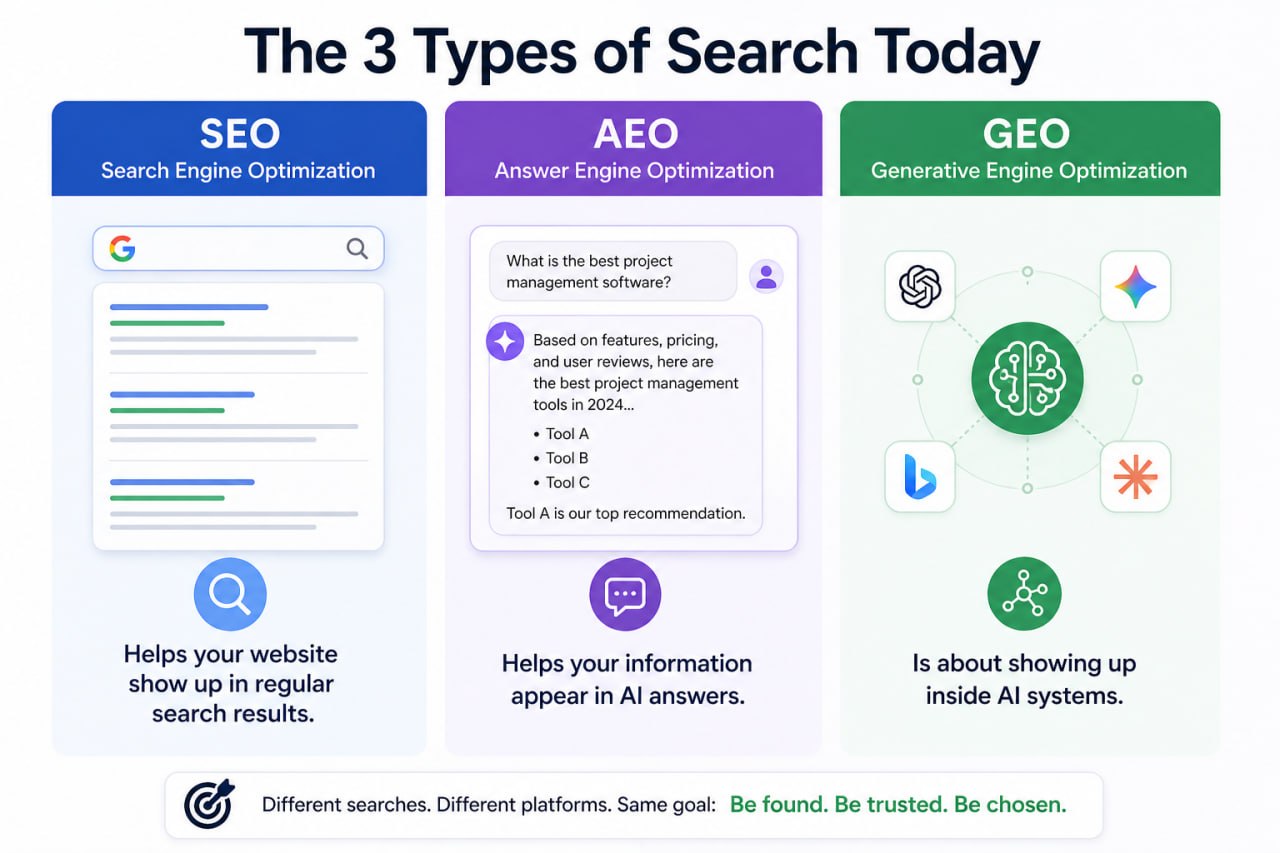
Modern visibility now breaks into three connected jobs. SEO gets you found in traditional search results. AEO gets you cited in AI answers. GEO helps AI systems understand and safely use your information.
| Aspect | SEO | AEO | GEO |
|---|---|---|---|
| Focus | Ranking web pages | Getting cited in answers | AI understanding |
| Goal | Appear in search results | Appear in AI answers | Appear in AI systems |
| Main Tactic | Keywords, links, tech | Clear answers, proof | Entity signals, schema |
| Best For | Product pages, local search | Informational content | All content types |
| Success Metric | Search ranking position | Citation mentions | AI comprehension |
For small businesses, the simple version is this: SEO gets you found. AEO gets you quoted. GEO helps AI understand and use your information.
How to Get AI Tools to Mention Your Business
AEO is not mysterious. It is clear writing supported by proof and machine-readable structure. Strong AEO usually starts with a direct answer block below the heading, followed by sections that mirror real customer questions.
Give your answer right away
Put a 40- to 60-word answer near the top of important pages. That makes life easier for both readers and AI tools.
Use real questions as section titles
Ask what customers actually type or say: What is this service? Who is it for? How much does it cost? What makes one provider better than another?
Make your business easy to understand
Your site should clearly state your business name, owner or founder, services, service area, industries served, customer types, proof points, success stories, reviews, and awards. Ambiguity is the enemy of AI visibility.
Back up what you say
Research, customer outcomes, case studies, comparison points, industry reports, screenshots, and original observations all help AI decide whether your claims deserve trust.
Use website code AI understands
Schema markup, LocalBusiness data, Organization markup, FAQ schema, service schema, and clean sitemaps all help machines read your site more accurately. Princeton University’s GEO research highlights how generative systems respond to signals that improve clarity, authority, and extractability [3].
Write content that compares and explains
AI tools love comparison questions because buyers use them before making decisions. Pages that answer “AEO versus SEO,” “best option for,” or “how to compare providers” often become easier for AI systems to cite.
Check Your AI Visibility for Free
Checklist for Small Businesses
Use this checklist to see whether your business is ready to be cited when AI tools answer customer questions.
Your website structure
- Add a clear answer at the top of your most important pages.
- Use section titles based on questions customers actually ask.
- Keep paragraphs short and easy to scan.
- Link related pages together so context is easier to follow.
- Make your contact information easy to find.
Trust signals
- Show the names of owners, leaders, or experts.
- Include reviews, proof points, and customer stories.
- State the industries you serve and the problems you solve.
- Use the same core company information across the web.
- Back up major claims with evidence.
Website code
- Add Organization or LocalBusiness schema where relevant.
- Use FAQ schema for visible question-and-answer sections.
- Add service information to service pages.
- Test pages with Google’s rich result and indexing tools.
- Make sure pages load fast and work well on phones.
Your content plan
- Write pages that answer customer questions directly.
- Create comparison content buyers actually need.
- Publish original observations, checklists, or small studies.
- Update older content with direct answers near the top.
- Add FAQ sections to your highest-value pages.
Check whether AI tools mention you
- Search for your business, services, and category in ChatGPT, Perplexity, Google AI Overviews, Gemini, and Claude.
- Write down which competitors appear and how each business is described.
- Note which sources the AI tools cite.
- Correct missing or inaccurate information.
- Repeat the check monthly.
AEO Do’s and Don’ts
Do
- Answer the question in your first paragraph.
- Back up claims with sources and proof.
- Use real customer questions as headings.
- Add business information such as your name, location, and what you do.
- Keep paragraphs short and scannable.
- Test visibility across multiple AI tools monthly.
- Update content when new information emerges.
Don’t
- Bury the answer under a long background explanation.
- Make vague claims without proof or sources.
- Use generic headings that do not match customer questions.
- Hide important business information.
- Create dense paragraphs that are hard to read.
- Assume one tactic works for every AI platform.
- Neglect to check whether AI tools actually mention you.
Get started in one week
- Day 1-2: Audit your top three pages and write down what customers actually ask before hiring or buying.
- Day 3: Add a 40- to 60-word answer block below each page heading.
- Day 4: Make your business name, location, and offer clear on every page.
- Day 5: Add proof such as reviews, numbers, statistics, or a case study.
- Day 6: Search for your business and services in ChatGPT and Perplexity, then document what appears.
- Day 7: Compare your visibility with a competitor and choose one improvement to make this week.
What This Means for You
The old goal in search was simple: rank higher. The new goal is bigger. Your next customer may ask ChatGPT, Perplexity, or Google AI who they should trust. They will read the answer and make a decision based on which businesses are mentioned.
Many competitors are still ignoring AI visibility entirely. That leaves the door open for you to become the cited source in your niche before they catch on.
Start with your three most valuable pages. On each one, place a 40- to 60-word answer right below the heading that directly responds to a customer question. Next, add your Organization schema code to help AI understand who you are. Third, back up your biggest claim with a source, statistic, or case study. Then publish one new piece of content each month designed to answer a question your customers actually ask. Finally, search for your business in ChatGPT and Perplexity every 30 days and note what changes.
The businesses that win this next phase of search will not be the ones complaining about fewer visits. They will be the ones that become the sources AI tools trust enough to mention when the stakes matter most.
Answer Engine Optimization Mistakes to Avoid
- Mistaking AEO for SEO: They work together, but they are not the same. You cannot ignore one to focus on the other.
- Writing for machines instead of people: AI tools prefer content that humans find clear and useful. Write for your customers first, then optimize for machines.
- Assuming your website automatically shows up in AI answers: You must actively optimize and test. AI visibility is not automatic.
- Neglecting to track whether you are being mentioned: Many businesses optimize without checking whether AI tools actually recommend them.
- Forgetting about proof: AI tools value sources backed by evidence. Vague claims get cited less often.
- Creating content only for AI: Real customers still read your material. The content has to work for both humans and machines.
Sources & References
This article references research and documentation from primary sources that help explain how AI-driven search is changing visibility.
- Google Search Central, “AI Features and Your Website” — Accessed April 2026.
- Pew Research Center, “Do people click on links in Google AI summaries?” — Published July 2025.
- Princeton University, “GEO: Generative Engine Optimization” — Published 2025.
- Google Blog, “AI Mode in Google Search: Updates from Google I/O 2025” — Published May 2025.
Frequently Asked Questions About Answer Engine Optimization
What is Answer Engine Optimization?
Answer Engine Optimization is making your website and business easy for AI tools to understand, trust, and mention. It focuses on clear answers, organized content, proof, and information that machines can read. Unlike SEO, which focuses on ranking pages, AEO focuses on getting your business mentioned inside AI answers.
Is regular SEO still useful in 2026?
Yes. SEO still matters for appearing in search results, local search, service pages, and keeping your website working well. Google says old SEO skills still work for AI features in Search. You should implement both SEO and AEO.
How is AEO different from SEO?
SEO is about getting your pages to rank in search results. AEO is about getting your business mentioned inside AI answers. SEO wins the list. AEO wins the answer. You need both.
What is GEO?
Generative Engine Optimization is about showing up inside AI systems. It includes clear information about your business, organized code that AI can read, claims backed by real sources, clear author and company information, and content that AI tools can safely share.
Can small businesses win in AI search?
Yes. Small businesses can win when their content is clearer and more detailed than bigger competitors. AI tools often pick the best answer, not just the most famous brand. This is your advantage.
What kind of content works best for AEO?
The best content answers real questions fast. Good formats include Q&A sections, comparisons, how-to guides, service explanations, buying guides, success stories, and original research. Content that matches how people actually ask AI tools questions works best.
How do I know if AI tools are mentioning my business?
Search for your business name, what you do, and the questions your customers ask across different AI tools like ChatGPT, Perplexity, and Google AI Overviews. Write down whether you appear, how you are described, which competitors show up, and which websites are mentioned.
How long does it take to see results from Answer Engine Optimization?
Initial visibility in AI search can appear within 4 to 8 weeks if your content is strong and clearly answers customer questions. Full ranking and consistent citations typically take 3 to 6 months. Timeline depends on content quality, competition, and whether your site is technically optimized for AI platforms.
Should I hire an expert for Answer Engine Optimization or do it myself?
You can start AEO yourself by improving answer clarity and adding trust signals to your website. For comprehensive implementation that includes code changes, technical fixes, and ongoing tracking, hiring a specialist or using a tool like Get Cited AI is usually faster and more effective.
What is the most important first step for Answer Engine Optimization?
Start with your most important pages. Add a clear, direct answer right below the page title. Make sure your business name, what you do, and who you serve are crystal clear. Then test whether AI tools can find and understand your information. Everything else builds from there.
How is Answer Engine Optimization different from SEO for AI?
Answer Engine Optimization and SEO for AI describe similar ideas, but AEO is the broader term. AEO includes content structure, trust signals, machine-readable code, and visibility tracking. It is not only about search ranking tactics adapted for AI.
Which AI tools should I optimize for?
Start with the major platforms: ChatGPT, Perplexity, Google AI Overviews, and Gemini. If your industry uses specialized AI tools, include those too. The principles of AEO work across platforms, so improving one usually helps the others.
Can I use schema code alone to improve my AI visibility?
No. Schema code helps machines understand your content, but it is not enough by itself. You also need clear answers on your pages, trust signals about your business, and proof to back up your claims. Schema is one tool in a larger AEO strategy, not the whole solution.
What if my business is very small or brand new? Can I compete in Answer Engine Optimization?
Yes. Smaller or newer businesses often win in AEO because they can create very clear, specific content. AI tools value the best answer, not the biggest brand. If you answer customer questions better than established competitors, you can earn citations.
Where can I learn more about Answer Engine Optimization for my specific industry?
Check Get Cited AI for industry-specific guides and visibility audits. Search for your industry plus Answer Engine Optimization, study what top competitors are doing, and then improve on it. Test your visibility monthly and adjust based on what you learn.
What to Do Next
Want to know whether AI tools are actually finding and mentioning your business? Run a free visibility check and see where you stand in the age of AI search.